Cue the scream! Cue the music! For 11 seasons I had watched Horatio Caine (played by David Caruso) speed across the grassy river in the opening shots of CSI Miami, so before we even stepped aboard the boat, I was giddy with excitement. I was finally getting the chance to take my own airboat ride through the Florida Everglades.
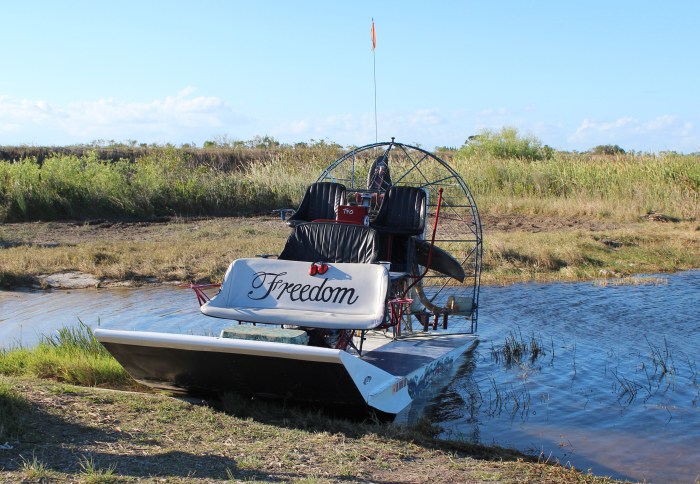
Our boat arrived, and as we were waiting for it to be refueled, I noticed that it was named appropriately, the Freedom.
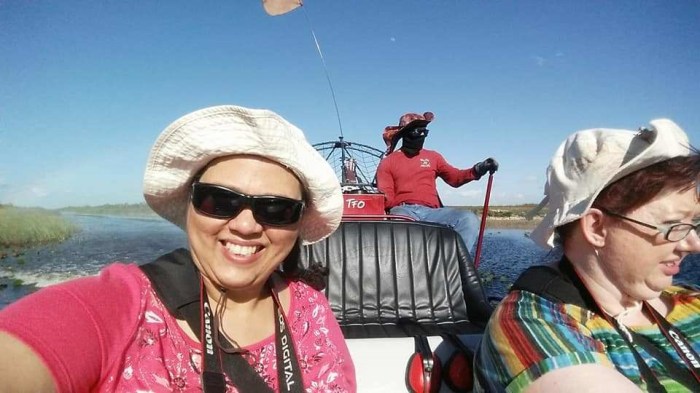
Our guide and pilot-extraordinaire, Lorenzo, of the Everglades Nature Tours, welcomed my sister and I aboard and helped us get settled before he revved up the engine, and off we flew.
As the flat-bottomed boat skimmed over the grasses and water, I couldn’t keep the grin off my face. What a rush!
Flying along with the wind whipping through your hair, you get the sensation that the pilot only slightly has control over the boat – kind of like when you do donuts on an icy parking lot in the winter – a little scary, but whole lot of fun. Of course, that free-wheeling sensation was only an illusion as Lorenzo had perfect control the whole time.
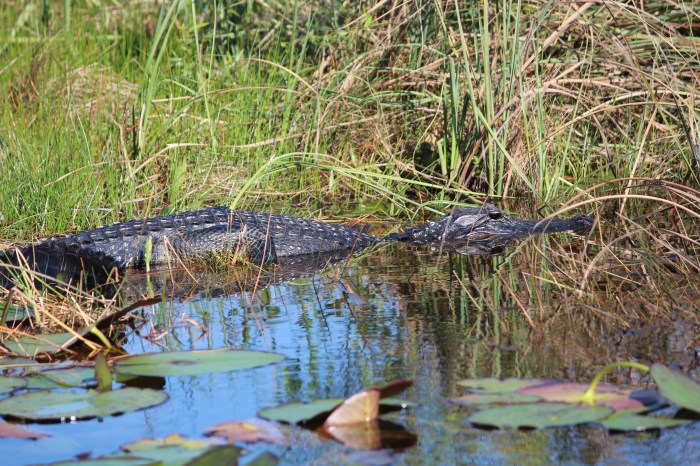
When you go to the Everglades, of course you want to see some alligators, and Lorenzo knew exactly where to find one. As we came up on the juvenile reptile, he slowed the boat to a crawl so we could ease up without spooking him. Even though we were quiet as we snapped dozens of photos, Mr. Gator seemed to glare at us as if to say, “Go away! I’m trying to nap here!”
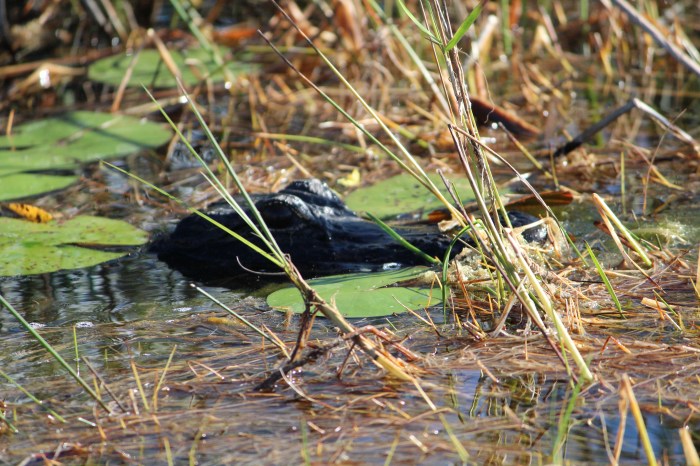
A second alligator, found further out into the Everglades, was not so patient with us, and immediately dived to avoid our cameras. A few moments later we caught him peeking at us while all but part of his head remained submerged.
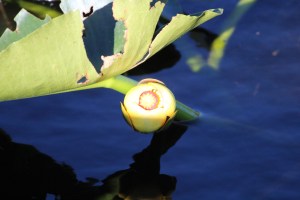
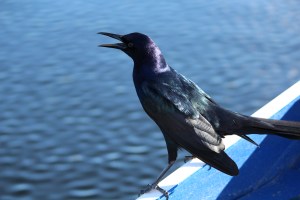
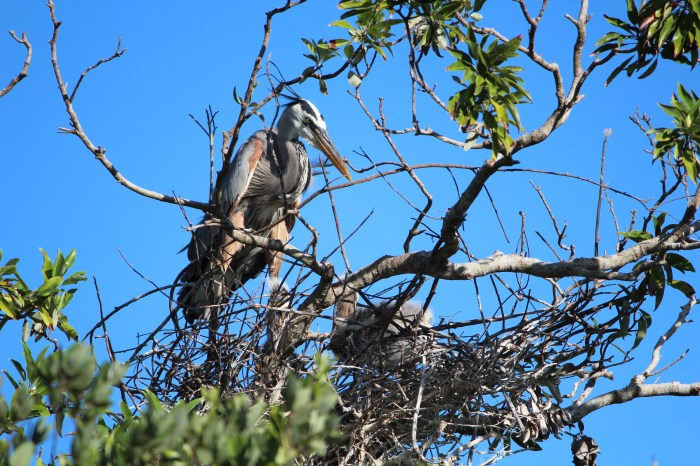
Around every bend there was a new discovery to be found. Lorenzo pointed out birds and plants and explained the practical or medicinal uses of several different kinds of grasses and flowers we found along the way. We watched a gigantic Blue Heron swallow a whole fish as she prepared to feed her chicks.
Before we knew it, an hour had passed, and we were coasting back into the docking area. What an hour it had been though! When you are out in the Everglades, the river of grass seems to go on forever until it meets at the horizon and joins with a sky that looks so vibrant and blue and big, it appears almost surreal.
It is an experience that should not be missed. If you find yourself near or in Miami, look up the guys at Everglades Nature Tours, and they will take you on a magnificent tour of a lifetime.
As far as I’m concerned, there is never a bad day to go to the beach. I would go every day if it were up to me. There is nothing more therapeutic than the sound of waves crashing on the shore. But since I live in southern Indiana, the only shoreline near my home is bordering the Ohio River. While our riverfront is beautiful and relaxing, it’s just not the same as the beach.
If my beach fix was limited to trips to the Atlantic, Pacific or Gulf Coast, I’d be in trouble. Luckily, there are miles of sandy, beautiful beaches just four hours to the north! From the Indiana Dunes National Park to the multitude of other beaches, Lake Michigan has sandy shoreline as far as the eye can see.
Recently I had the pleasure of visiting Michigan City, Indiana – a town that is a perfect getaway destination. My husband was there on business, and I got to tag along, and we turned the down times into a two-day getaway vacation. Michigan City has historic sites, a Casino, theater, music venues, great restaurants and bars, parks, and (of course) beaches.
Since it was such a quick trip, we didn’t get to go everywhere on our list. (I guess that just means we’ll have to go back again soon!) However, we had the opportunity to visit several amazing places, including Michigan City’s Washington Park Beach.
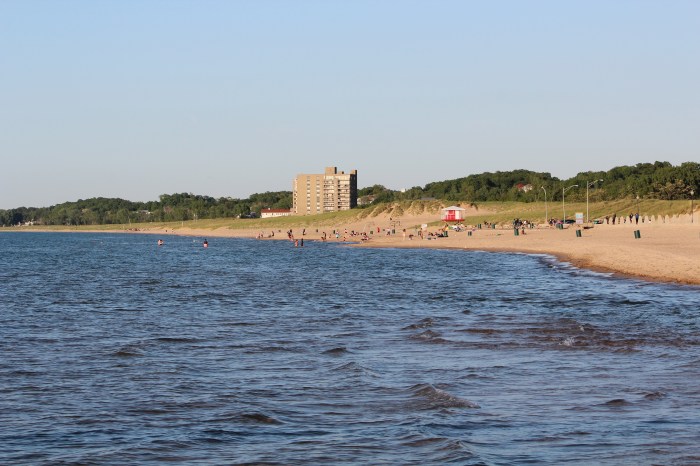
One of the things I love about beaches on the Great Lakes is you have the sensation of being at the Ocean without all the wildlife risks, meaning there are no sharks, jellyfish or stingrays to worry about! Like the ocean, however, you do have to pay attention to the water conditions. Big water is big water, and like the ocean, waves can get rough, and riptides form on a regular basis. So, use caution when swimming, and pay attention to the flags posted at the beach.
Washington Park Beach has life guards on duty during the day, which makes it the perfect place to take your family. The beach is beautiful and clean, with restrooms and concessions on the beach. It’s the perfect place to swim, wade and look for shells and sea glass.
Michigan City has lots to do!
Just a short walk down the shore is the Old Lighthouse Museum, located at 100 Heisman Harbor Road, in Washington Park where you can learn about Great Lakes history and the role lighthouses had in that history. The museum is open from 1 p.m. to 4 p.m. Tuesday through Sunday from April to October. Admission is $5 for person age 14 and older, $2 for persons younger than 14, and free from preschool age and younger.
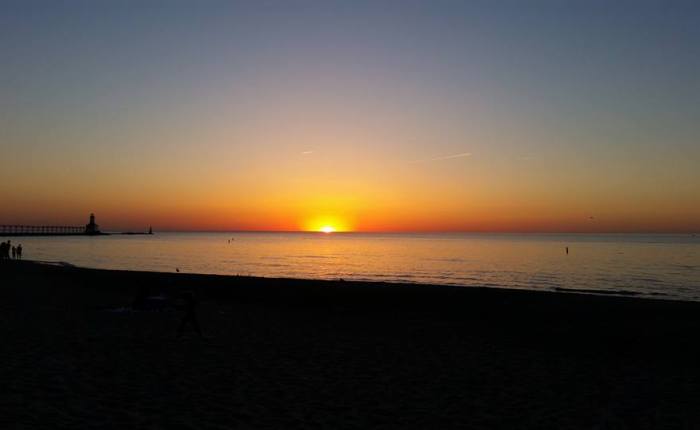
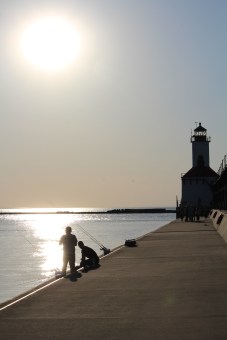
If you want to see a working lighthouse, just follow the walkway along the shoreline to the Michigan City Lighthouse. The walkway is a great place from which to throw out a fishing line or kick back and watch the sunset – or do both at the same time!
If you need even more stuff to do, Washington Park also offers a zoo, a senior center, a splash park, picnic shelters, a boat launch, a marina, public fishing areas, a fish cleaning station, public art, and a restaurant. Also, if Washington Park’s beach isn’t enough for you, the Indiana Dunes National Lakeshore is just west of Michigan City and offers many miles of beautiful beaches.
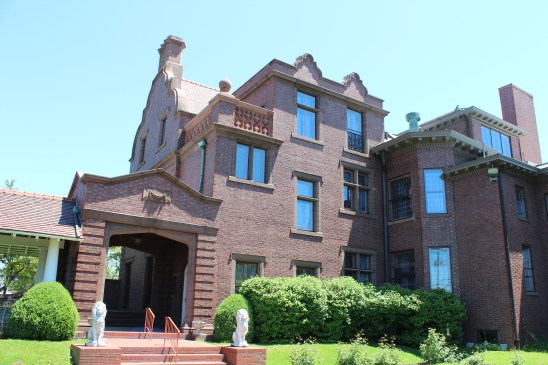
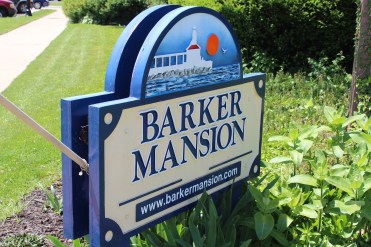
However, if your family is like mine, just going to the beach is not enough to keep active offspring happy. Michigan City has tons of things to do and see. There are several museums, including the Historic Barker Mansion, a beautifully preserved Victorian-era home built in the 1800s by one of Michigan City’s most important citizens, or the Hesston Steam Museum or the Hoosier Valley Railroad Museum.
If art and theater is your thing, you’re in luck. Michigan City has a variety of art galleries, and the Canterbury Theatre offers a full season of plays, musical theater, and concerts. Need more excitement? The BlueChip Casino has a blackjack table or slot machine waiting just for you! (Just remember to play responsibly.)
Finding a tasty meal
After a full day of beach lounging, museum tours, and whatever else you manage to crowd into your day, a good meal is more than necessary. During our stay in Michigan City, we ate at several restaurants. A couple really stood out from the rest.
First, let me suggest Galveston Steak House. A family-owned restaurant, located at 10 Commerce Square, Galveston believes in great food, big portions, and friendly service. Eating there was a great way to end a wonderful day.
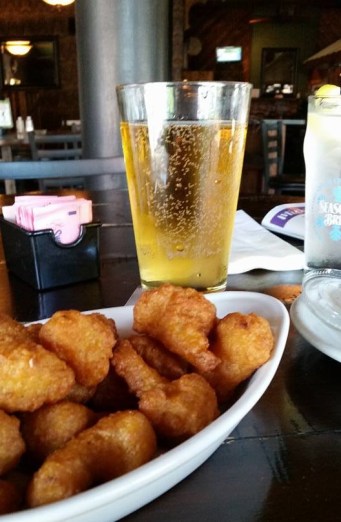
I also had the opportunity to pop into Ryan’s Irish Pub and Restaurant, located at 401 Franklin Street. I was just looking for a snack and something to drink, but boy did I get more than I bargained for! I had skipped lunch so I asked for an order of deep-fried cauliflower, thinking it would be a little something to get me through until dinner. What came to my table was a huge heaping bowl of deliciousness! Stop in for a snack, but you may want to bring someone with you to help eat it!
Staying in Michigan City
Accommodations in Michigan City run from one extreme to the other. We stayed at the BlueChip Casino in a room which I consider to be a typical no-frills hotel room. I recommend you check out the other accommodations offered in the town as the walls at the BlueChip are thin, making for a noisy abode. If you’re visiting on a budget, there are campgrounds and RV parks available, with some offering cabins. On the other end of the spectrum, there are several hotels, including the BlueChip, that offer luxury suites. The city also has a variety of beautiful B&Bs, or you can opt to rent a beach house through a site like HomeStay.
Regardless of where you decide to stay, your visit to Michigan City is sure to be a highlight of your summer. I know my family is excited to spend a couple days this summer enjoying the beaches near Michigan City.
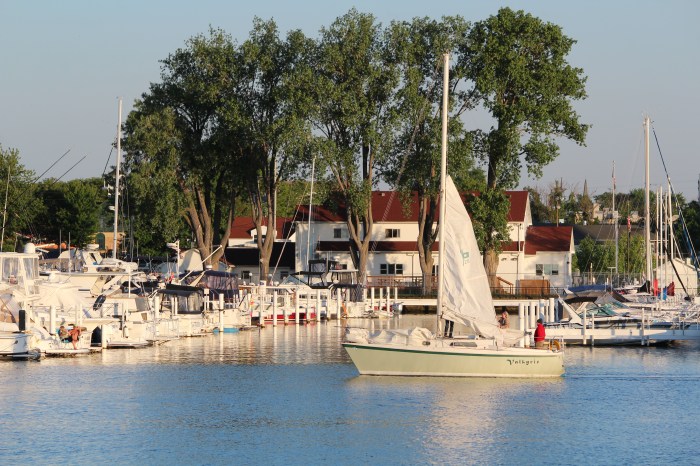
It’s fun watching boats sail in and out of the marina at Washington Park.
All photos are the property of V. Lori Hedges, and may not be used without permission.
I knew before we left for our trip, that Tyler and I had to reserve at least one day to visit a beach in Cuba. After all, you can’t go island and not go to the beach!
Months before I had watched an episode of Anthony Bourdain’s Parts Unknown which highlighted Santa Maria Beach in one of his story segments. “That’s where we are going,” I told Tyler. So, toward the end of our trip, we called up our friend, Pedro, and asked him to take us to Santa Maria Beach for the afternoon.
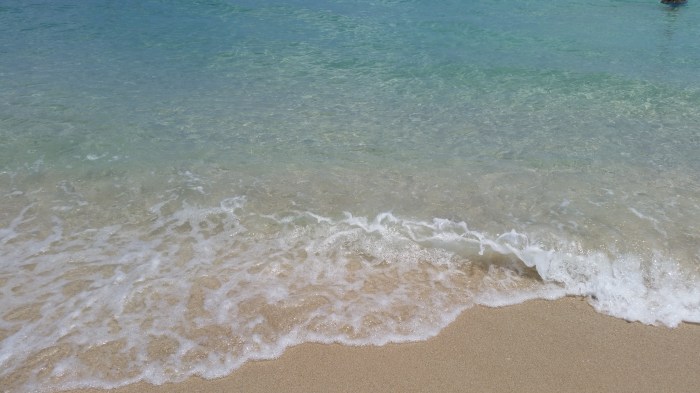
We were not disappointed! Although it was a hot day, the water was perfect. And because it was in the middle of the week, it was not at all crowded. According to Pedro, most Cubans go to the beach during the late afternoons on the weekends.
I really think it is the most beautiful beach I’ve ever visited. You could see straight to the sandy bottom; the water is that clear. The day we were there, the water was very calm with minimal undertow – a perfect place to take young children for a dip in the ocean.
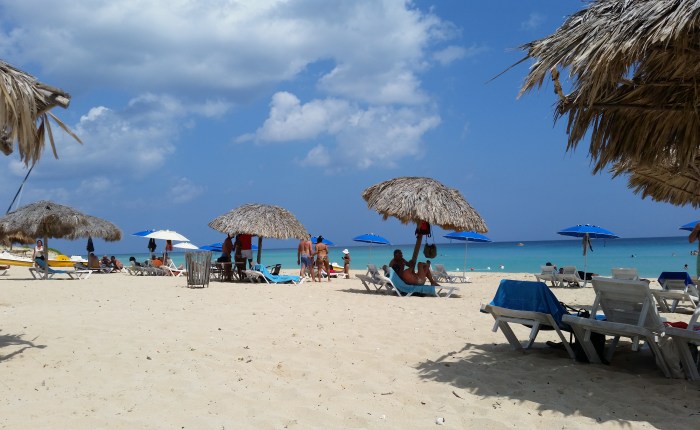
Large portable beach umbrellas and chairs are available for rent or you can just claim a spot under one of the fixed palm-leaf umbrellas dotting the shoreline. We chose to do the later and spread out a blanket on the sand underneath it.
At the beach entrance is a bar and restaurant where you can purchase everything from sandwiches and soft drinks to cocktails and beer. The bar’s restroom is also conveniently available for changing into your swimsuit.
We swam, lounged, and people watched (most of our fellow beach goers were European and Canadian tourists) for more than four hours. After the hustle and bustle of Havana, Santa Maria Beach was a soothing balm to the soul.
For sure, this beach tops my list of favorite oceanside places! If you make it to Havana, make sure you set aside some serious time to check out this jewel of a beach!
Last thought
As I sit and reflect on my 10 days in Havana, there are a few thoughts I’d like to leave with you before I go onto my next adventure. To begin with, I just want to say that the people of Havana are wonderful, friendly people. They welcome you with open arms.
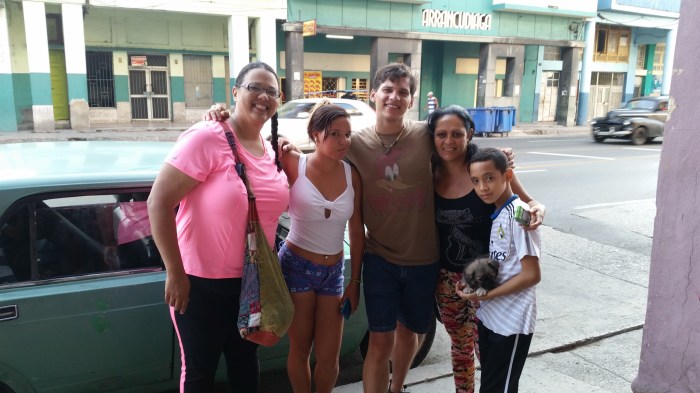
With our host family (from left) – Lori, Yanara, Tyler, Yeny, Anibal, and Maluma (the puppy).
Our host family, Yeny, Anibal, and Yanara feel like family, and we miss them like crazy. Our new and wonderful friends, Julio and Tomasa, opened their home and lives to us, and we so cherish them. Pedro is so much more than a taxi driver to us, and we loved our conversations together as he took us from place to place. There are so many others that we were just barely getting to know – Sylvia, Sisi, Leo, and Felix – we can’t wait to come back and get to know you all better.
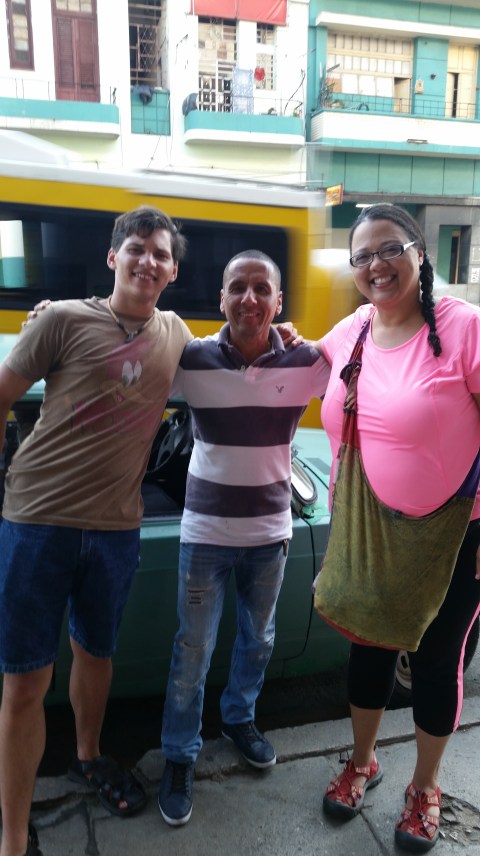
Tyler and me with our friend, Pedro.
I’ve never traveled to a place where I’ve gained so many friendships so quickly. I didn’t expect to feel so connected to this city, but it has become a part of me, and I am glad.
Havana is a major metropolitan city – yes, it’s literally crumbling in many places, but it’s also beautiful. There are signs of revitalization going on in just about every neighborhood as displaced Cubans are returning to invest in their country.
My only hope is that as Cuban nationals gain more and more access to modern amenities, they won’t forget that new is not always better. I hope they will never discard their neighborhood butchers, bakers, and produce stands that provide them with wonderful fresh foods and instead replace them with American-style supermarkets that specialized mainly in heavily processed foods with ridiculously long shelf lives.
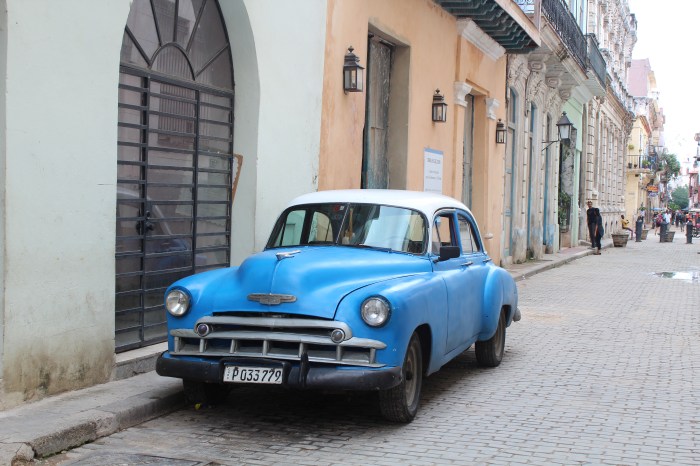
I hope they will continue to repair and maintain the wonderful 1950s cars that are so famously Havana when new car dealerships begin springing up around the island. I also hope they will remain true to the historical aspect of architecture as renovations and new construction projects become more common around the city.
Havana, and the rest of Cuba, is going to experience growing pains as money and opportunities begin to flow into the country from the United States and elsewhere. This country that has struggled for more than 60 years is full of extremely resourceful and artistic people. They know how to “not just manage,” but to thrive with less, and they do it with an amazing zest-for-life attitude. I hope that as they experience gain, they won’t lose their strong character traits in the process.
Havana, even as large as it is, has a kind of “Mayberry” feel to it in that people still have a front-porch society. Everywhere you go, people are sitting in their doorways or on their balconies watching the activities around them. It is common to hear greetings shouted from the sidewalk, and neighbors spend time visiting each other daily. Families go to the neighborhood parks regularly to spend recreational time together and to meet with friends. They talk face to face. People there are connected, and not just on Facebook. I hope they never lose that.
Gracias, Havana. We will be back.
All photos and video are the property of V. Lori Hedges, and may not be used without permission.
The blue-gray glow seeping through the cracks around the shutters and the increase in honking horns and roaring engines on the street below signals that a new day has begun in Havana. I open my balcony doors and do what the locals do – step out and lean on the railing to watch the show taking place around me.
Taxi drivers are already out in full force, piloting their world-famous vintage autos as they troll for customers eager to part with 7 to 10 CUCs to avoid walking to their destination. The neighbors across the street are busy hanging laundry on the balcony clothes lines – a perpetual sight in Cuba.
Right now, the air is a pleasant 70 degrees with a cool ocean-fueled breeze. However, as the sun continues to climb the sky, you know that within the hour the air will change to hot and sticky. Even in April, shorts and lightweight shirts with sandals are favored attire.
From the next room, I hear the call to breakfast from my hostess extraordinaire, Yeny. She has set out a literal feast: three plates of fresh fruit – pineapple, mango and bananas – and a pitcher of freshly squeezed juice – usually pineapple or mango. At each place setting a dinner-plate-sized omelet waits to be savored. A secondary plate holds a ham and cheese sandwich on a freshly-baked roll from the bakery down the street. The meal is topped off with strong Cuban coffee served with hot milk.
My son, Tyler, and I relish the fruit which was picked ripe and bought from the neighborhood produce stand. (We squirrel away the ham and cheese sandwich for our midday meal.)
By the time we finish our breakfast and get ready for our day, temperatures have soared into the mid-80s. It’s time to hit the streets in search of musicians to interview for our documentary.
The first full day in Havana, we weren’t sure where we wanted to begin our search for people to video and interview. The night before Tyler had gone for a walk and had gotten lost – a happy accident really since he now had a bit of an idea about the lay of the land. “There is a really beautiful church down the street that you should see, he said. So off we went in the direction of the church.
La Iglesia de Carmen
The doors were open so we stepped into the dim quietness of the sanctuary. An older lady was kneeling in one of the front rows, silently talking with God. A younger man stood in the isle reverently looking up at the statues of saints. In the hush of the room, the click of my DSLR sounded too intrusive. After a few close-up shots, I switched to my phone camera.
Although I am not Catholic, I felt compelled to spend a few moments in prayer before I continued my wander about the room. In a place where the communist government discourages religion, this church had obviously been preserved with love.
Our visit was cut short when a nun from the adjoining convent began closing up the doors for the mid-morning break. It was time to move on down the street.
We had walked several blocks down the street, and had stopped next to a building to discuss where to go next when a smiling man approached us.
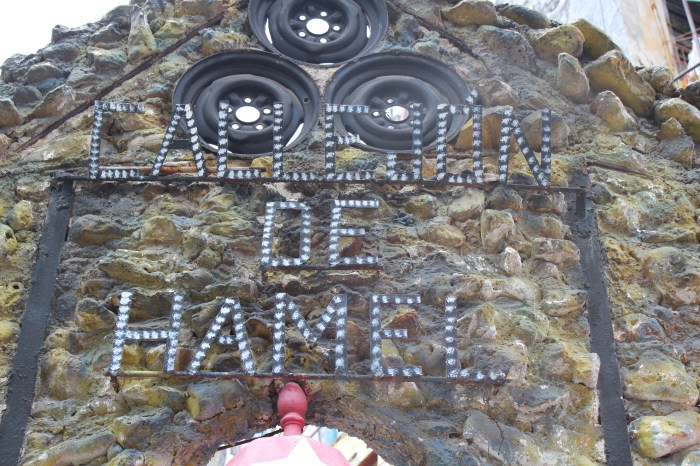
“Hello! Where are you visiting from?” Felix Javier asked in heavily-accented English. He introduced himself and explained that he is a promotional representative for the artist community of Callejón de Hamel. “Hamel,” he said was a couple blocks from where we were standing. He described the place as part art gallery and part music venue. It sounded like just the place for which we were looking. Felix also introduced his friend and business partner, Leo Moré, noting that Leo is a Rumba drum teacher in Hamel, as well as a tour guide.
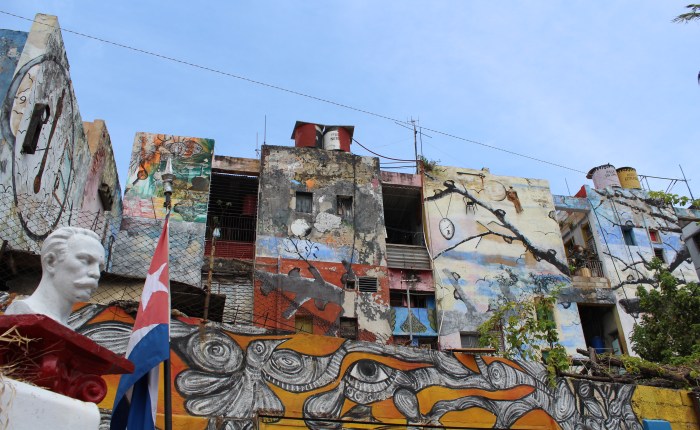
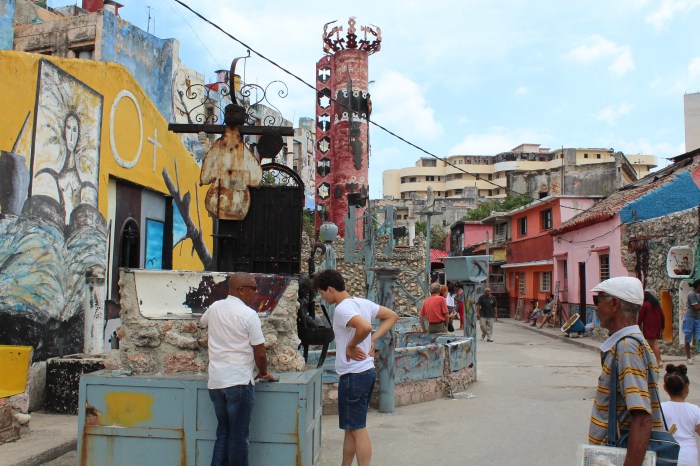
The four of us walked the few short blocks to Hamel which is located between Armburu and Hospital streets. There is no other way for me to describe Callejón de Hamel than as an alley covered in a riot of color. Brightly painted Murals and sculptures ingeniously made from all manner of recycled stuff line the narrow winding street.
“It is better to hand over weapons than to fight without morals.”
I marveled at the colorful (and very useful) benches fashioned from discarded iron bathtubs. Intriguing sculptures made from old auto parts and other items which dotted the area, depicting a variety of human forms. Most of the murals and sculptures are by Cuban artist Salvador González, who started the alley project in 1990. Now people from all over the world, including celebrities, make a point of visiting the alley when they are in Havana.
Felix tells Tyler the history of the art in Hamel as Leo looks on.
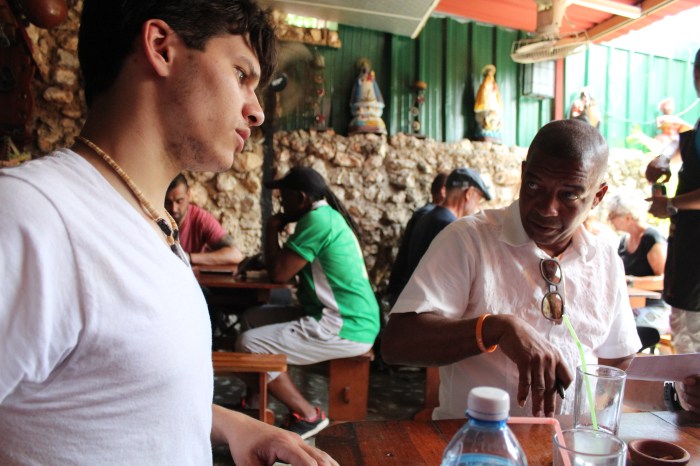
Halfway through the tour, Felix directed us to a bar called “El Barracón de Hamel, where he introduced us to the Cuban cocktail, the Billongo, a mixture of honey, rum, lime, mint, and ice. Although it proved to be very tasty, I decided the 90-degree temperatures and high humidity called more for a bottle of water than a rum beverage.
Felix explains something to Tyler during our break at El Barracón de Hamel.
The bar itself has its own claim to fame as a mecca for celebrities, the most recent being Mick Jagger, who stopped in for a drink when the Rolling Stones were in Havana to perform a free concert last year.
While in the bar, Leo, who speaks only Spanish, shared a bit of his life story as a Cuban musician. As a young man, Leo had traveled the world and performed on television with a Cuban National Music Group. He laid well-worn photos out on the table and noted that out of the dozens of band members, only a few are still alive to tell the stories of those days. Most have died, he said, but a few fled to the United States.
Today, Leo teaches people of all ages the art of Rumba drumming. He also performs with other Rumba musicians each Sunday in Hamel.
We made an appointment to return and formally interview Leo and shoot footage of him playing. Then Felix took us to an indoor gallery of Salvadore’s smaller works before we said goodbye to our new friends and took our leave at the opposite end of the alley.
What an afternoon it had been! We learned so much, saw some beautiful art, heard some great music, and got to know some interesting people … and that was only our first day exploring Havana!
From left – Leo More, V. Lori Hedges, Felix Javier, and Tyler Hedges at the Callejon de Hamel.
Notes about visiting Callejón de Hamel
If you visit Hamel with one of the many guides (like Felix and Leo), understand they are not giving you a tour out of the kindness of their hearts. This is their job. They expect to be tipped.
Also, if you stop at El Barracón de Hamel for refreshments, they will expect you to pick up the tab. If you’re not willing to do so, you need to tell them up front.
There are many musicians there selling CDs of their music which, according to several with whom I spoke, provide money for scholarships for the Rumba school in Hamel. They offer the CDs for 10 CUCs each. If you don’t want one, politely, but firmly say “no” and keep walking.
Do visit on Sunday around noon if you want to see what the Rumba school is all about.
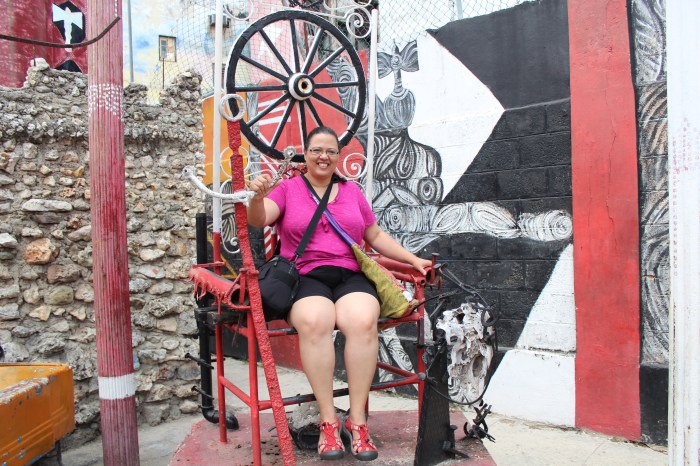
Lori in the “King’s chair.”
Below: Tyler and Leo collaborate on one of Tyler’s original songs, “Crazy.”
All photos and videos are the property of V. Lori Hedges, and may not be used without permission.
He did not want to look at the fish. He knew that half of him had been destroyed. The sun had gone down while he had been in the fight with the sharks. “It will be dark soon,” he said. “Then I should see the glow of Havana.. If I am too far to the eastward I will see the lights of one of the new beaches.” I cannot be too far out now, he thought. I hope no one has been too worried. There is only the boy to worry, of course. But I am sure he would have confidence. Many of the older fishermen will worry. Many others too, he thought. I live in a good town. He could not talk to the fish anymore because the fish had been ruined too badly. Then something came into his head. “Half fish,” he said. “Fish that you were. I am sorry that I went too far out. I ruined us both. But we have killed many sharks, you and I, and ruined many others. How many did you ever kill, old fish? You do not have that spear on your head for nothing.”
-Excerpt from “The Old Man and the Sea” by Ernest Hemingway (published in 1952)
I think I was in seventh grade when I was assigned to read Hemingway’s famous story about the old Cuban fisherman, Santiago, and his solo quest to bring in a large Marlin. At that age, I didn’t even remotely appreciate the story or the talent that created the prose. It was just an assignment that I had to read for a grade. However, as an adult, I can recognize why Hemingway is such a celebrated author.
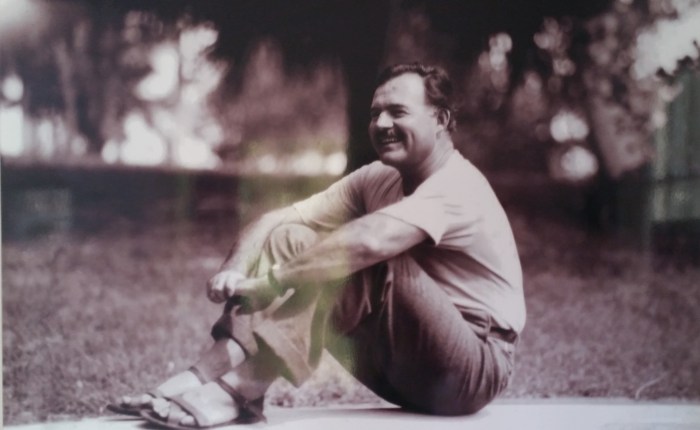
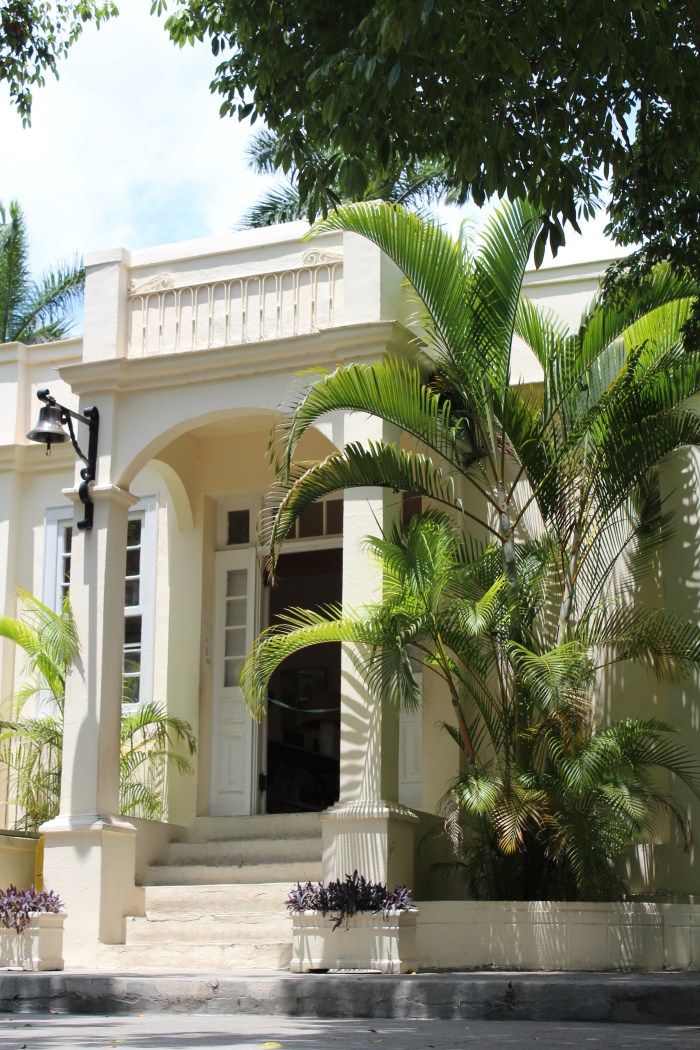
Also, although I was aware of his status as a hunter, fisherman and all-around-man’s-man, I really didn’t know much about his history, especially concerning Cuba. Visiting Finca Vigía or Farm Lookout, located in the town of San Francisco de Paula just outside of Havana, gave me a fresh and intimate look at the life of one of America’s most important writers.
Lush vegetation borders the sweeping drive leading up to what is now known as the Hemingway Museum. After paying the 5 CUCs admission fee, you are directed up the remaining length of driveway where the sprawling house is perched at the crest of the hill. A flight of steps leads you to a broad veranda that boarders the house on all sides. Visitors are permitted to look through the open windows and doors, but are prohibited from entering.
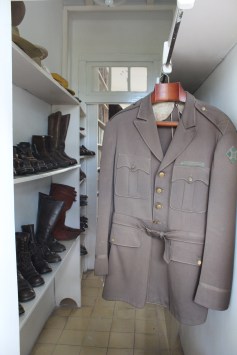
As I stood in the doorway of the main entrance, I got the feeling that the great man had just skipped off to Havana for a visit to a favorite bar or that he’d headed off for a day of fishing. The house is as he left it. His vast collection of books sit ready for him on their shelves. Record albums are laid out waiting to be played. His clothes are neatly hung in his closet.
Hemingway spent more than 20 years in Cuba. When he left Cuba in 1960, he simply closed the house and left for Spain. It is believed he planned to return sometime in the future. However, physical illness and an onset of mental illness, forced Hemingway to return to the United States to his other home in Ketchum, Idaho. After enduring several hospitalizations, Hemingway committed suicide on July 2, 1961. Following his death, the Cuban government obtained possession of Finca Vigía and decided to turn it into a museum honoring this friend of the Cuban people.
It is said that Ernest Hemingway loved Cuba and its people, especially the hardworking fishermen that populated the small coastal villages near Havana. Today, his memory is honored, not only by the museum, but at the landmark places he loved and patronized around Havana during his time living on the island. In fact, Cuba has declared that Havana is Hemingway’s “real home.”
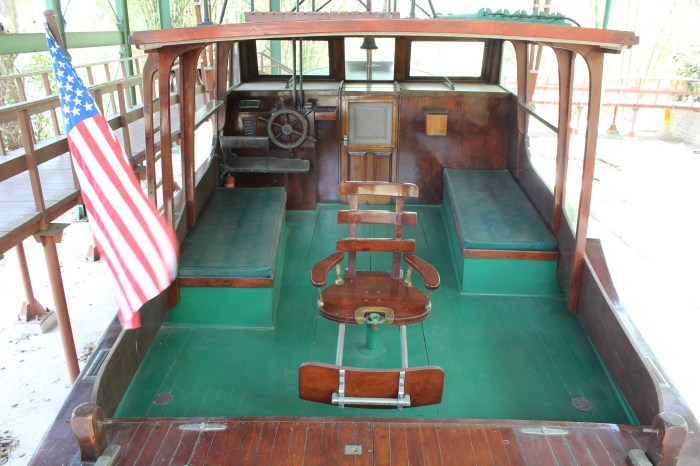
I found Finca Vigía to not only be a very beautiful place, but also very inspirational. In my mind, I could imagine him in his office, standing barefoot on his rug as he hammered out a book on his Corona typewriter. I could “see” him entertaining celebrity guests, such as Ava Gardner and Spencer Tracy, around the sparkling swimming pool. I could visualize him battling to land a big fish on his yacht, the Pilar.
Hemingway was a man with a big personality and a big, bold life. He lived for adventure. Whether it was as a decorated soldier, a celebrated war correspondent, a social activist, or a Pulitzer-prize winning author, the man known as Papa was the epitome of carpe diem. Viewing Finca Vigía and learning more about Hemingway’s history reminded me yet again that life is not a rehearsal, and we only pass this way once so we need to live boldly.
Visiting his home in Cuba has also sparked a desire in me to take another look at his celebrated works – just to see what all the fuss is about. I think I’ll start by rereading “The Old Man and the Sea.”
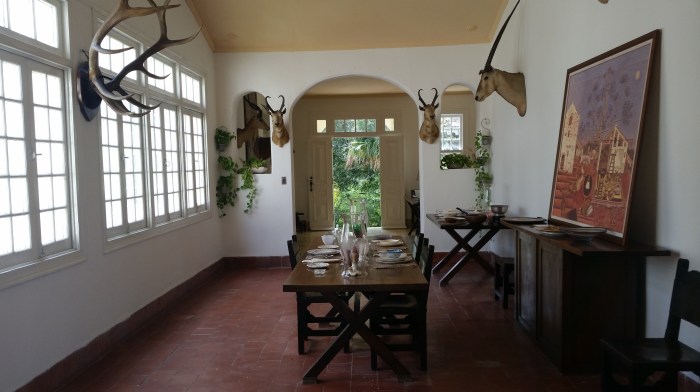
The dining room where the Hemingways entertained many of their guests.
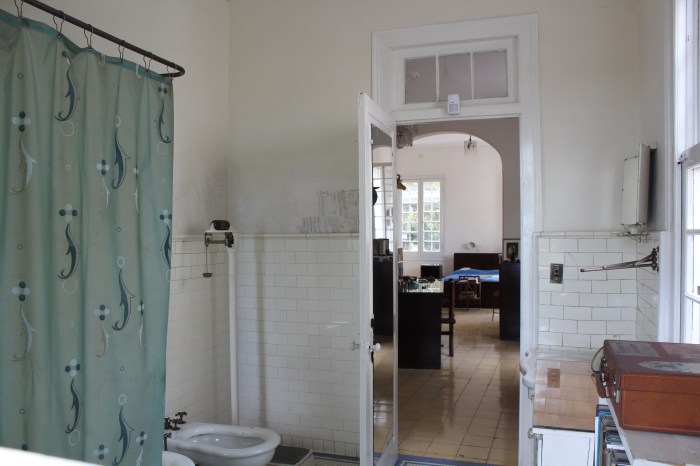
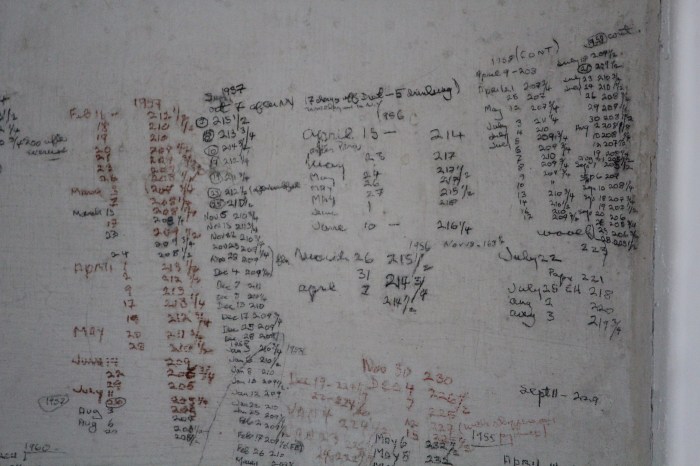
Hemingway kept track of his weight by writing it on the bathroom wall near the scales.
The tower that Hemingway used as a lookout.
The author kept a telescope in the tower.
The view from the tower.
The great room.
Hemingway’s bedroom
Art collection
He loved big game hunting.
Part of his music collection.
The Pilar
His bedroom
Graves of his beloved dogs.
The pool
***
To find out more about our adventures in Cuba, stay tuned for Part 5!
All photos are the property of V. Lori Hedges, and may not be used without permission.
Havana is a city of rich history, vibrant art, and lively music, with plenty for a visitor to see, hear, and experience. However, when my son, Tyler, and I set out on our adventure to live in Havana for 10 days, we had one main objective: Film a documentary. Our lesser objectives were, for me – to gather material for this travel blog and to shoot photos for an art show – and for Tyler – to play music with Cuban musicians.
Through these objectives, we planned to see and experience as much of Havana as possible. However, because we were so busy meeting people and working, we had little time to tour most of the places tourists usually go.
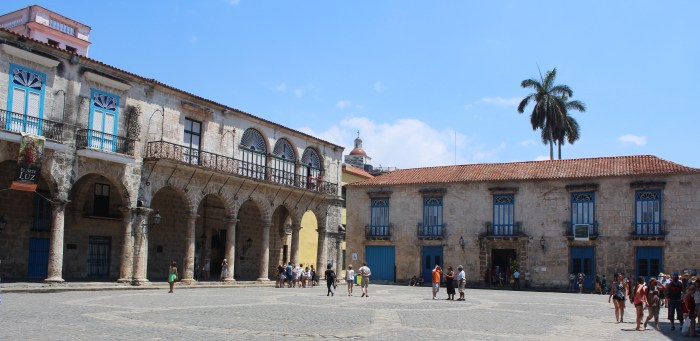
The Museo de Arte Colonial (right building) is located in the Plaza de la Catedral.
We didn’t get to tour the following places during our trip, but they were on our list of places to see and are certainly worthy of consideration when you make up your own Cuba itinerary. Here are a few places to consider:
Museo Nacional de Bellas Artes – Edificio de Arte International
Calle Trocadero e/ Zulueta y San Jose, Habana ViejaOpen Tuesday through Sunday from 10 a.m. to 6 p.m. Admission is 5 CUCs for one building or 8 CUCs per person for both galleries.
Museo Nacional de Bellas Artes – Edificio de Arte Cubano
Calle Trocadero e/ Zulueta y Monserrate, Habana ViejaOpen Tuesday through Sunday from 10 a.m. to 6 p.m. Admission is 5 CUCs for one building or 8 CUCs per person for both galleries.
Museo de Arte Colonial
San Ignacio #61 e/Empedrado y O’Reilly, Habana ViejaNo admission
Museo de la Revolución
Refugio #1 e/Avenida de las Misiones y Zulueta, Habana ViejaOpen Daily from 10 a.m. to 5 p.m. Admission is 5 CUCs.
Castillo de los Tres Reyes del Morro
Northeastern Side of the HarborOpen daily 10am-7pm daily; Lighthouse: 9am-8pm daily. Admission is 4 CUCs.
Catedral de la Habana
Empedrado #156 e/San Ignacio y Mercaderes, Habana ViejaOpen Monday through Sunday from 10:30 a.m. to 3 p.m. Admission is free.
This list barely scratches the surface of the places that should be on your list to see. For a more comprehensive list of information on what to tour in Havana, visit www.lahabana.com.
TASTY TREATS
While you are in the Old Havana area, you may also want to take a break and drop in at La Bodequita del Medio, Ernest Hemingway’s favorite hangout, for lunch or a refreshing libation from the originators of the mojito. However, these days, this famous writer hangout is THE place to go if you’re a tourist so be prepared for an elbow-to-elbow, standing-room-only situation.
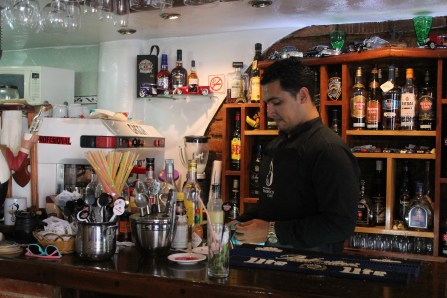
If you’d prefer a quieter place to lunch and recharge, you might consider the Barroco Café, just off the Plaza de la Catedral on Calle Mercaderes. You can watch the chef’s make your meal from the dining area while you sip one of the best Piña Coladas you’ll ever taste!
SHOPPING
Venders selling paintings on the sidewalk in Old Havana
Old Havana is also the perfect area to purchase inexpensive souvenirs. Shops line the streets offering everything from the expected T-shirts to musical instruments and paintings of all sizes. The Troubadours who walk the streets in search of an audience also often offer CDs of their music, usually for about 10 CUCs. Whether you’re shopping from a cart on the street or a proper souvenir shop, don’t be afraid to haggle as you’ll often get a better bargain.
Since Americans can only travel to Cuba for official activities, planning several visits to the Old Havana area during down times is a good strategy to fit in a bit of tourism. Old Havana has enough cultural activities, shopping and food options to fill out your time for several days without having to spend a lot of time driving or walking. The streets are full of music, historical sites, art, and interesting people. Enjoy!
Tips for Sightseeing in Havana:
Wear comfortable, sturdy shoes. Streets in Havana are often uneven, and you will be walking a lot.
Go early in the day or later in the evening to avoid the hot, sticky temperatures of midday.
Carry toilet paper and wet wipes with you. Most public restrooms do not have toilet paper or soap and paper towels.
Carry a bottle of water with you to avoid dehydration.
Wear sunscreen and a hat! The Havana sun in brutal, and you don’t want to spoil your trip with a painful sun burn.
Carry some change for bathroom fees and tips for musicians.
***
Stay tuned for Part 4 as we visit Ernest Hemingway’s Havana home: Finca la Vigía or Lookout House, located in the town of San Francisco de Paula.
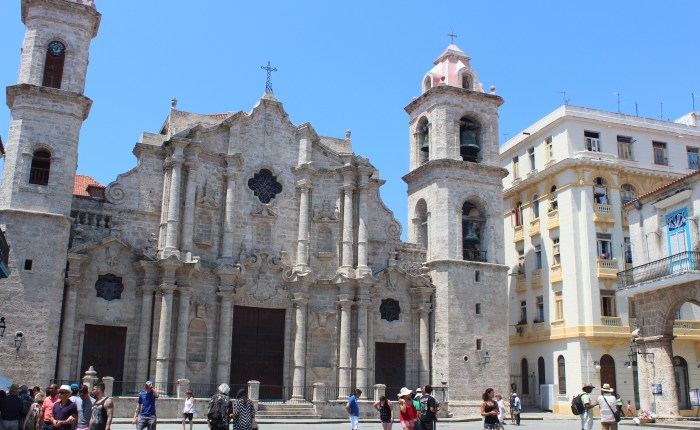
(Featured photo is the Catedral de Havana.)
All photos are the property of V. Lori Hedges, and may not be used without permission.
Beautiful countryside, sandy beaches, lush groves of coconut palms and banana trees, a colorful history with a lot of historical sites to see, restaurants, and tourist shopping: Cuba has all of that. But when you first step off the plane at the José Marti International Airport, you are met with the fact that this is also a country ruled by the strong hand of a dictator.
The arrival area of the Havana airport doesn’t have the big, spacious welcoming atmosphere of a U.S. International Airport. Instead, arriving visitors to the island nation are funneled to a rather grim, intimidating room. There they are greeted with the task of standing in a very long line where eventually their passport is scrutinized and stamped before they are sent to stand in another long, slow-moving line to go through “an airport-type” security where carry-on bags are scanned and people are sent through a metal detector. Finally, passengers are sent to the baggage claim area to get their checked bags before they must stand in another long line for customs.
The author, after successfully maneuvering security and customs, joins her fellow travelers in the hunt for a taxi.
Once a person finally escapes the lines and exits into the hot Cuban sun, they have a couple of choices: stand in yet another eternally-long line to exchange their currency for Cuban CUCs, or find a taxi who will drive them to a money exchange in the city and then on to their hotel or casa particular. Our taxi driver suggested the latter option for which we were very grateful.
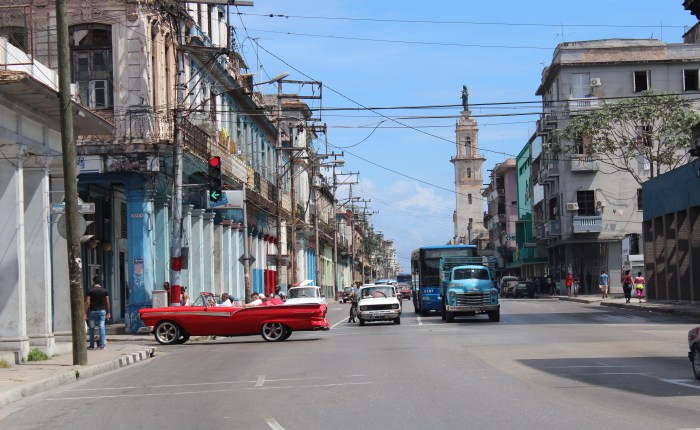
As our taxi weaved through the Havana streets (at what seemed at times an incredible speed), we got our first glimpse of the city that would be our home for the next ten days. Having done some research before our arrival, I expected to see evidence of decades of living with embargos and shortages. Buildings, cars, clothes, shoes – virtually everything must last for years as new things are very difficult to obtain.
Things we take for granted in America, like oil filters and other pollution control parts for our cars, are almost non-existent in Cuba. Want a steak? Good luck finding one unless you patronize one of the very exclusive new establishments in Havana. The average Cuban dines primarily on chicken and pork. Even seafood is scarce for the typical Cuban household, which seems ridiculously strange considering Cuba is an island nation. I was told most of the seafood is reserved for export purposes.
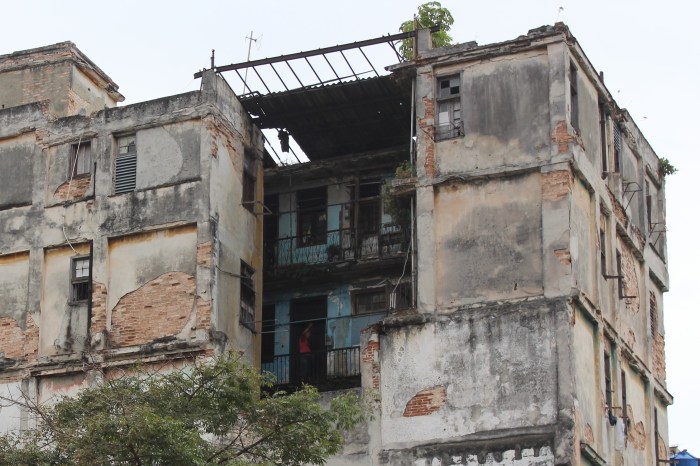
I’m not going to lie to you. There is a lot – and I mean A LOT – of poverty in Havana and all of Cuba. There are people living in partially crumbling buildings that look like they are in the middle of a demolition project. Once I was taking a photo of such a building, when I realized there was a man waving at me from the balcony of one of the apartments.
Above a man spies me taking his photo and waves.
Later, I met a woman, named Maris, who lived with her daughter, husband, and mother-in-law in a two-room hovel. Her living room and kitchen combination space was about the size of an 8×10 bathroom, with a similar-sized room above which served as the family’s sleeping room. Despite her obvious needs, Maris was happy that I wanted to talk with her, and she more than willingly shared information about herself and her city.
The thing that was really brought home to me while discovering this wonderful culture is that life is what you make it. You can be angry and filled with self-pity because of your difficult circumstances (and some Cubans, like Maris, have some pretty tough circumstances), or you can make do and make the best of things while looking forward to better times.
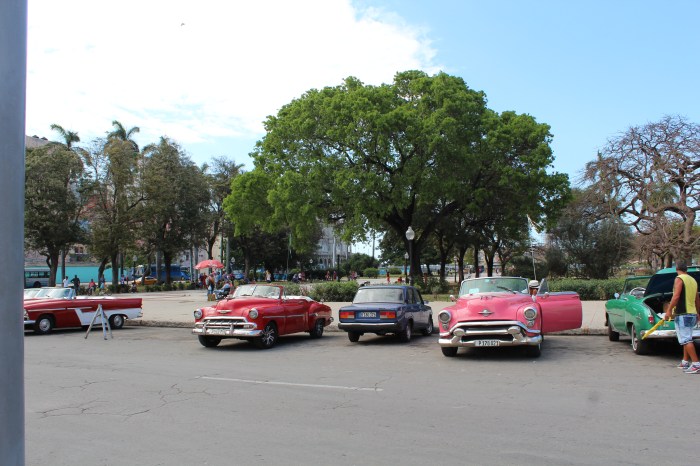
The Cuban people are experts at “making do” and turning something old into something newly useful. The most visible examples of this skill are the hundreds of vintage cars that cruise around the city streets. Those 1950 cars have been rebuilt, repainted, vigorously maintained, and often rigged with soviet parts to keep on running, and run they do. Most Cuban vintage car owners are very proud of their vehicles, and they keep them shined up to prove it. I know more than a couple old-car enthusiasts here in the United States that would give some serious money to own a couple of those cars!
Colorful vintage cars line the street near the capitol building while taxi drivers wait for clients.
As I walked about Havana and talked with more and more of its citizens, I soon forgot about much of the economic deficiencies, and I fell in love with this gracious old city. Everywhere I went, I was greeted with warmth. If I needed assistance, there was always someone who was happy to help. It was so easy to meet people, and by the second day there, we had already made several new friends. My life has been permanently changed for the good because of my days in Havana.
***
In part 3 of my Havana series, we’ll discover some of the sites you won’t want to miss on your trip to Cuba!
All photos are the property of V. Lori Hedges, and may not be used without permission.
The United States has had a complicated relationship with the country of Cuba since the 1960s, and bringing up the subject of Cuba incites a variety of responses from people depending on whether or not they lived through that era.
Older people remember things like the Soviet threat and the Cuban missile crises, while younger people think only of the Cubans who are desperate to escape the island that is both a home and a prison. Then, of course, there is the actual prison at Guantanamo Bay about which many horror stories have been told.
Regardless, people are usually pretty polarized about Cuba as a travel destination. So when I announced my intentions to go to Cuba and film a documentary, I received quite a few strong opinions from friends and family.
Most negative sentiments came from those who were primarily concerned for my safety. After all, I was going to this scary communist country which is run by a dictator so I was most certainly going to be in constant peril.
As I set about making my reservations, I did discover that finding information about navigating the country is a bit confusing, but finding accommodations is easy. You can elect to stay at one of the large resort hotels which cater to impressing tourists, but I recommend staying with one of the many HomeStay hosts if you want to get an authentic Cuban experience.
Since I had no way to contact interview subjects before my trip, (and I really had no clue how it was going to be to do the project in a culture I had yet to experience) I decided the only option I had was to “wing it.” The story would develop out of whatever I and my son, Tyler, discovered in our wanderings around Havana.
So, I booked our flight, filled out the necessary online forms for our visa and packed our bags. Of course, when I arrived at the Louisville airport I was again asked to fill out the same visa information forms and then pay the $50 fee for each of us.
Our connection to Cuba was the Atlanta International Airport where we were again asked to fill out the same necessary forms for our visa. Then I had to fill in the blanks on the actual visa form with absolutely no errors, and no cross-out or over writes. If you make a mistake, you must purchase another $50 visa, but no pressure!
With that finished and accepted, the difficult part was over, and we were off to Cuba. A little over an hour later, we caught our first glimpse of this complicated country filled with the most amazing people!
***
To find out more about our adventures in Cuba, stay tuned for Part 2!
All photos are the property of V. Lori Hedges, and may not be used without permission.
Planning a family vacation is always a difficult task. How much can you spend? Where will you stay? How will you get “X” number of people to the destination? Those are questions that must be answered for just about any trip, but when teenagers are a part of the equation, the struggle increases with each teen added to the mix.
A vacation with teenagers is an active venture. They rarely are happy just spending a week lounging in a beach chair around a pool while reading a good novel. They want to be doing things and seeing things. This causes a challenge for families that have a mixture of ages. Often parents are just looking for a relaxing holiday. Younger kids often are fine with days splashing in a pool or playing on a playground. Teenagers, however, want to go, go, go. Finding that sweet spot where everyone is happy is tough.
Here are two quick and easy solutions if you are planning a vacation with your teenagers:
Take a cruise. There are several cruise lines that really cater to families with children and teens. Look for cruises that offer kid camps for the younger children – they will be kept busy doing all kinds of crafts, recreation, and sciency stuff – and teen-oriented activities – they will be kept busy doing all types of physically-challenging activities, such as learning to surf in the surf pool or participating in an improv show. Meanwhile, parents are left to do or not do whatever they want, guaranteeing that everyone will get the vacation of their dreams.
Look at all-inclusive resorts for families. These resorts, like family cruises, specialize in activities for a variety of ages, keeping the teens and children entertained and parents relaxed.
But what if you don’t want a cookie-cutter vacation. What if you’re looking for something more adventurous and unique? There are a few things you need to consider as you make your plans:
What are the ages of the people going on the vacation?
How many people are in the party?
What are the interests – music, sports, hobbies – of each person going on the trip?
How active is each person and what is their fitness level?
What kind of location does each person prefer? Beach? Mountains? City? Country?
What kind of weather does each person prefer? Cold? Hot?
Are they adventurous or more reserved?
How are you traveling? Driving? Flying? Train?
How far away can you go?
How much can you spend?
All of the answers to these questions will help you to determine where you’ll go and what you’ll do on your trip. My husband and I have six sons. Two are working adults, two are college students, and two are high school sophomores. Having a two- or three-year gap between the boys has made planning vacations a real challenge in the past. When the oldest two boys were around 9 to 11 in age, the youngest were just babies, and a lot of activities were hard to do with babies in tow. When the older kids were teens, they didn’t want to participate in the “baby stuff” that was appropriate for their elementary age brothers.
It was very frustrating. It is equally frustrating now. My oldest four boys are over 21, which opens up a lot of options for us, but the youngest two are 16, which eliminates many of those options again. Despite these problems, we have managed to take some pretty spectacular trips the past couple of years. So where do you start?
First of all, just know that one or more of your children (no matter their age) are going to indicate they don’t want to go and do whatever you are planning. That’s okay. Proceed. They don’t know, really, that they are going to have a good time. My boys always think my ideas for trips are “boring,” but they always come away saying, “Thanks, Mom, I had a great time.” The trick is to plan a trip that has a balance between intellectual growth, physical activity and relaxation.
A Balance of intellectual stimulation, physical activity and relaxation is the key to a successful vacation when traveling with teenagers.
Everyone will learn something if you pick a museum about your teen’s favorite subject.Hiking, bicycling, or boogey boarding are all good activities to burn off some of your teen’s abundance of energy.Make sure you plan time to just relax and unwind.
So armed with the information from the questions above and an overall budget for your trip, start by making a list of three cities or locations that sound promising. When we were searching for our summer vacation destination, I picked Washington D.C., Savannah, Ga., and Miami, Fla. Right off the bat, I eliminated Miami since we were driving, and we didn’t want to spend the entirety of the trip in a van.
I knew Washington D.C. is a happening city so that is where I began my research, with my first internet search being “Things to Do in Washington D.C.” I made a list of places and activities I thought would interest various family members who were going on the trip and included the admission prices of each activity. Then I began plotting an itinerary to see what was feasible to do in the time we had allotted. (Washington D.C. has so much to do, much of which is free.) Then we had a short family meeting to discuss the options for activities if we went with a D.C. trip.
We had pretty much settled on D.C. and had even booked our hotel rooms through Booking.com which offers the “pay-when-you-stay” option. However, in order to stay within our budget, we had to book a hotel in Manassas, Va., which meant a lot of driving through D.C. traffic. We looked at taking the train into the city at least one time, which sounded kind of fun, but that was pretty expensive with six people in the group. By the time we crunched the numbers, D.C. had grown way out of our comfort zone as far as budgeting was concerned.
Also, the trip was leaning heavy on intellectual growth, but I figured all the walking from one attraction to another would provide enough physical activity for balance. However, I was concerned that there was not enough down time for those of us who needed some relaxation included in the itinerary. So it was back to the drawing board, with another round of research.
Then I started researching options in Savannah and Tybee Island in Georgia, and things just started to fall together. It didn’t take long to determine that this was the perfect destination for my family. There was something for everyone: sightseeing, activities, and beach time. At the end of the trip, everyone agreed that Savannah and Tybee Island were amazing destinations for our group. (See my stories on those two destinations in my blog listings.)
Now the family wants to celebrate the holidays with a trip instead of the traditional gift-giving routine, so I’m back to researching. My oldest son has requested beach time, so southern coastal destinations are the main focus. This time we have 10 or 11 people in our group so it’s going to be an even bigger challenge to please everyone, but I feel confident that my method will again result in a successful vacation!
***
What vacation destination has been your family’s favorite? Also, if you have any suggestions for a Christmas vacation destination (with beaches), I’d like to hear from you. Share in the comments below!
All photos are the property of V. Lori Hedges and may not be used without permission.
Copyright 2016 V. Lori Hedges. All Rights Reserved.





















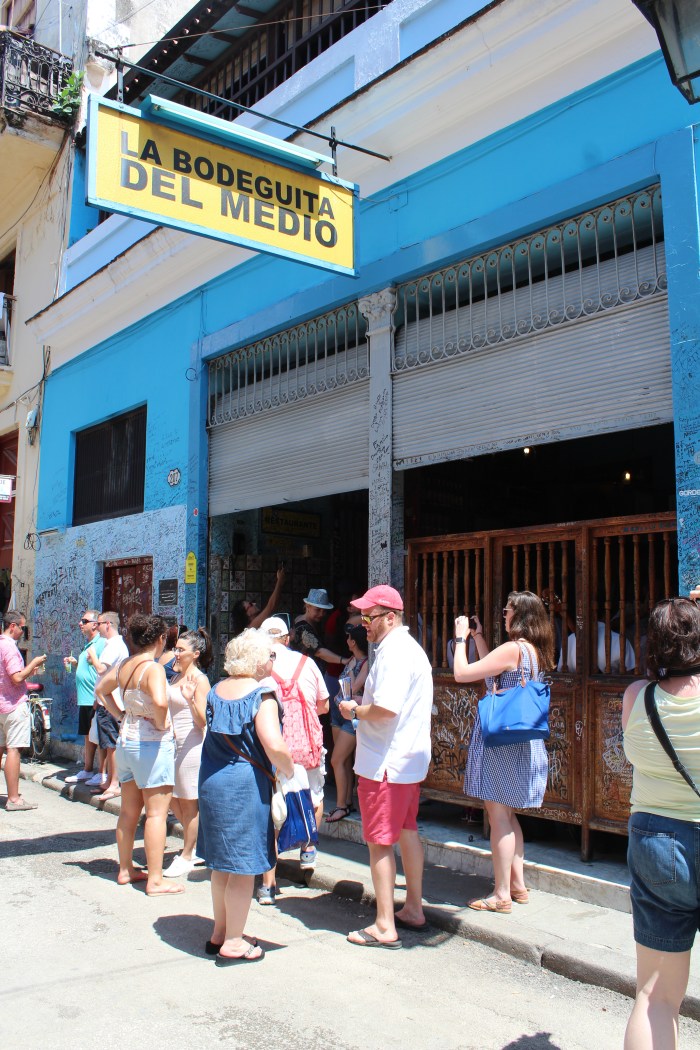 While you are in the Old Havana area, you may also want to take a break and drop in at La Bodequita del Medio, Ernest Hemingway’s favorite hangout, for lunch or a refreshing libation from the originators of the mojito. However, these days, this famous writer hangout is THE place to go if you’re a tourist so be prepared for an elbow-to-elbow, standing-room-only situation.








 destinationinvestigations