Part 2
By V. Lori Hedges
Beautiful countryside, sandy beaches, lush groves of coconut palms and banana trees, a colorful history with a lot of historical sites to see, restaurants, and tourist shopping: Cuba has all of that. But when you first step off the plane at the José Marti International Airport, you are met with the fact that this is also a country ruled by the strong hand of a dictator.
The arrival area of the Havana airport doesn’t have the big, spacious welcoming atmosphere of a U.S. International Airport. Instead, arriving visitors to the island nation are funneled to a rather grim, intimidating room. There they are greeted with the task of standing in a very long line where eventually their passport is scrutinized and stamped before they are sent to stand in another long, slow-moving line to go through “an airport-type” security where carry-on bags are scanned and people are sent through a metal detector. Finally, passengers are sent to the baggage claim area to get their checked bags before they must stand in another long line for customs.
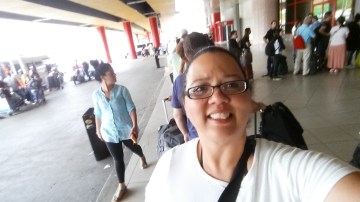
Once a person finally escapes the lines and exits into the hot Cuban sun, they have a couple of choices: stand in yet another eternally-long line to exchange their currency for Cuban CUCs, or find a taxi who will drive them to a money exchange in the city and then on to their hotel or casa particular. Our taxi driver suggested the latter option for which we were very grateful.
As our taxi weaved through the Havana streets (at what seemed at times an incredible speed), we got our first glimpse of the city that would be our home for the next ten days. Having done some research before our arrival, I expected to see evidence of decades of living with embargos and shortages. Buildings, cars, clothes, shoes – virtually everything must last for years as new things are very difficult to obtain.
Things we take for granted in America, like oil filters and other pollution control parts for our cars, are almost non-existent in Cuba. Want a steak? Good luck finding one unless you patronize one of the very exclusive new establishments in Havana. The average Cuban dines primarily on chicken and pork. Even seafood is scarce for the typical Cuban household, which seems ridiculously strange considering Cuba is an island nation. I was told most of the seafood is reserved for export purposes.
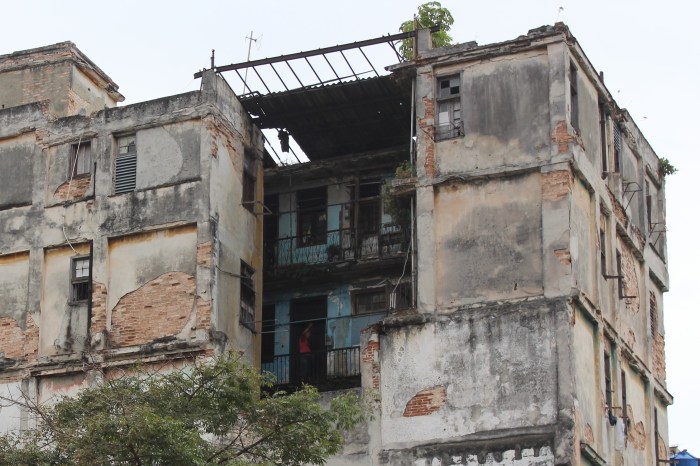
I’m not going to lie to you. There is a lot – and I mean A LOT – of poverty in Havana and all of Cuba. There are people living in partially crumbling buildings that look like they are in the middle of a demolition project. Once I was taking a photo of such a building, when I realized there was a man waving at me from the balcony of one of the apartments.
Later, I met a woman, named Maris, who lived with her daughter, husband, and mother-in-law in a two-room hovel. Her living room and kitchen combination space was about the size of an 8×10 bathroom, with a similar-sized room above which served as the family’s sleeping room. Despite her obvious needs, Maris was happy that I wanted to talk with her, and she more than willingly shared information about herself and her city.
The thing that was really brought home to me while discovering this wonderful culture is that life is what you make it. You can be angry and filled with self-pity because of your difficult circumstances (and some Cubans, like Maris, have some pretty tough circumstances), or you can make do and make the best of things while looking forward to better times.
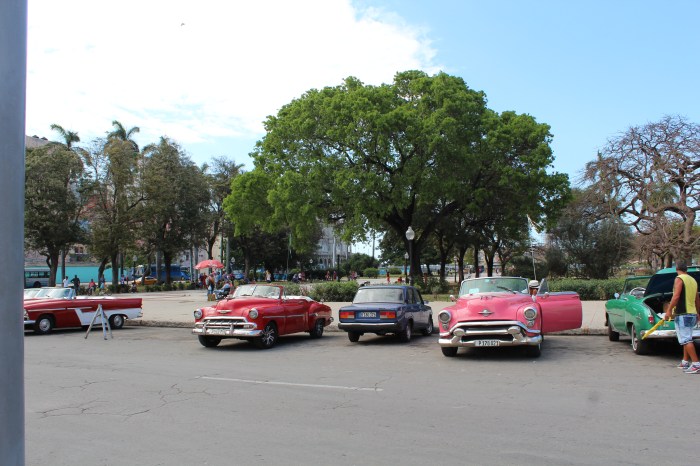
The Cuban people are experts at “making do” and turning something old into something newly useful. The most visible examples of this skill are the hundreds of vintage cars that cruise around the city streets. Those 1950 cars have been rebuilt, repainted, vigorously maintained, and often rigged with soviet parts to keep on running, and run they do. Most Cuban vintage car owners are very proud of their vehicles, and they keep them shined up to prove it. I know more than a couple old-car enthusiasts here in the United States that would give some serious money to own a couple of those cars!
As I walked about Havana and talked with more and more of its citizens, I soon forgot about much of the economic deficiencies, and I fell in love with this gracious old city. Everywhere I went, I was greeted with warmth. If I needed assistance, there was always someone who was happy to help. It was so easy to meet people, and by the second day there, we had already made several new friends. My life has been permanently changed for the good because of my days in Havana.
***
In part 3 of my Havana series, we’ll discover some of the sites you won’t want to miss on your trip to Cuba!
All photos are the property of V. Lori Hedges, and may not be used without permission.

 destinationinvestigations