

By V. Lori Hedges
Two years ago, my family and I enjoyed a short trip to Savannah and Tybee Island, Georgia. Both areas were so beautiful and rich in history that we vowed to return as soon as we could. This summer we made good on that vow. This time, however, we had seven glorious days to spend enjoying this beautiful place, with lots of time for exploring or for doing nothing at all.
Fort Pulaski, located on Cockspur Island within sight of Tybee Island, was one place we couldn’t fit into our tight schedule last time, so we moved it to the top of our list of places to visit. My sister and I took advantage of a couple of sunny hours (before a rain storm moved in) to head over to the fort to expand our knowledge of southern history.
My family and I are very into history and visiting historical sites. But, despite the fact we have visited many historic sites, I was unprepared for how this place made me feel. Built in the early 1800s, the garrison’s 7-1/2-foot walls are constructed of giant slabs of stone and around 25 million bricks. According to park literature, most of the structure was built by slaves borrowed from nearby rice plantations. Although it happened almost 200 years ago, I felt pity for the laborers who had to work and sweat in the oppressive heat to build those massive walls.
The fort was originally built as a part of a campaign to secure the U.S. coastline from foreign threats. However, when neighboring South Carolina seceded from the United States and the union army was able to secure Fort Sumter in Charlestown, Georgia’s governor ordered the state’s militia to seize Fort Pulaski for the state. Later when Georgia seceded, it became a Confederate strong hold. What happened a year later is still recorded by the cannon projectiles imbedded in the outside walls.
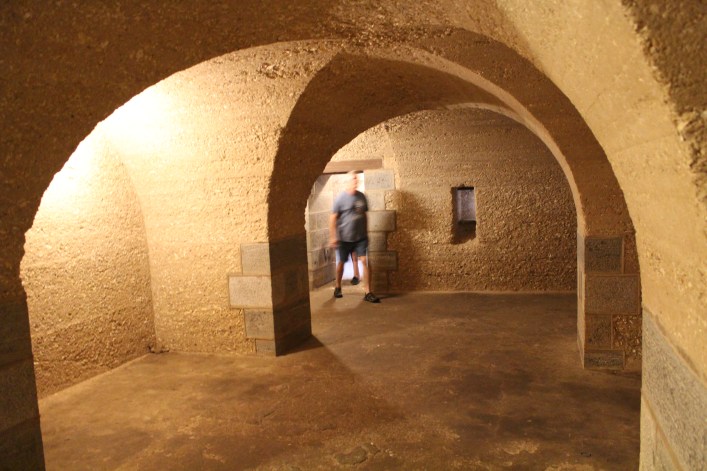
Under the cover of night, the Union Army positioned rifled cannons in strategic locations across the water on Tybee Island. Because they didn’t know the Union was equipped with this new cannon technology, the Confederate soldiers thought they were safe and secure from the Union threat. Surely cannon couldn’t reach the walls from that far away, they thought, musing that if a cannon ball did happen to hit the fort, it would do little damage.
The battle lasted 30 short hours. The mighty garrison was no match for the rifled cannons and their capability to fire from far greater distances than traditional cannons. With massive holes blown in its side, Fort Pulaski was forced to surrender to the Union Army. For the rest of the Civil War, Fort Pulaski was a Union strong hold that allowed the United States to control the shipment of goods up the Savannah River. It also served as a prison for captured Confederate soldiers where many died of disease and starvation.
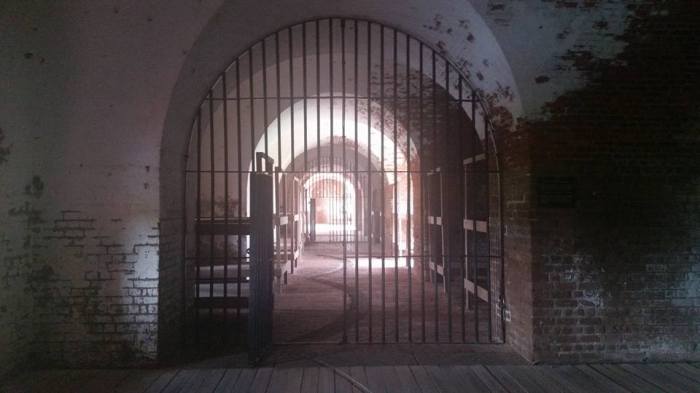
Today Fort Pulaski stands proudly as one of our National Historic Monuments – a portal to the past – allowing visitors a chance to learn about what life was like on Cockspur Island in the 1800s.
As we meandered around within the walls of the fort, I could almost see the military personnel keeping watch along the upper walls while others tended to the massive cannons and other tasks around the interior. On Saturday’s, costumed reenactors populate the fort to give visitors an even more authentic experience as they go through the ceremony of firing several of the cannons on the garrison wall.
But even if you visit on a weekday, you just might meet a soldier in uniform. Since dozens of southern soldiers who were imprisoned there also died there, it is not surprising that people claim to see and hear their ghosts throughout the fort – even in the middle of the day.


Besides the fort itself, there are trails surrounding the garrison which allow visitors to explore the island’s plants and wildlife. And, although you can’t cross to it, there is a trail that takes you to a great vantage point to view the Cockspur Island lighthouse. Unfortunately, we didn’t get to take advantage of those offerings as about the time we finished our tour of the fort, the downpour arrived.
There is so much to learn here. The national park service has provided dozens of detailed plaques explaining how each area was used. There is also a wonderful short film in the welcome center about the battle between the Confederate and Union armies. As I walked around the fort, I couldn’t help but feel that the walls themselves were saturated with deep emotions: hope, deep despair, happiness, fear, pride, weariness … So much has happened here.
Fort Pulaski is such an interesting place. If you’re traveling near Tybee Island, I recommend you set aside a couple hours to wander around this historical gem. Admission is very inexpensive: $7 per adult. If you’re on vacation, this will probably be one of the least expensive, but most enriching experiences of your trip. I hope you find it to be as engaging as we did.
All photos are the property of V. Lori Hedges, and may not be used without permission.

 destinationinvestigations