Amazing Adventure on the plains of South Dakota

Amazing Adventure on the plains of South Dakota

By V. Lori Hedges

At the beginning of our road trip, I said there are three staples that you need for the journey: traveling music, snacks, and a flexible travel plan. I guess Day Six of our epic road trip was our day to exercise flexibility.

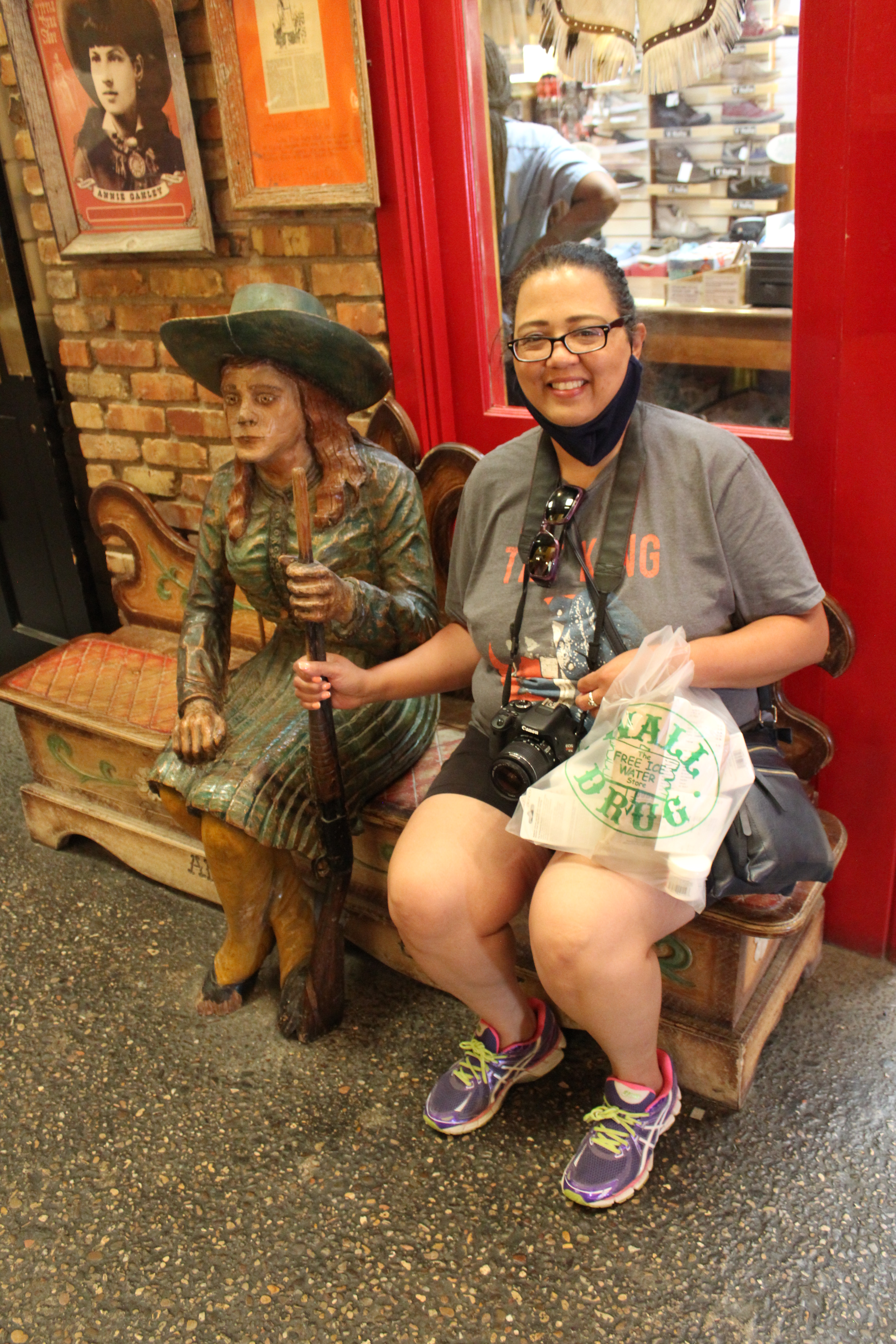
The day began with us driving the four blocks from our hotel to Wall Drug for breakfast. If you’ve never been to Wall Drug, I can only describe it as a touristy destination filled with old west memorabilia mixed with souvenir baubles to create a massive sensory overload, and yet it still manages to be a fun place to stop. Just to warn you though, Wall Drug can be an expensive visit. Our pretty standard breakfast fare ended up being the most expensive breakfast I’ve ever paid for anywhere.

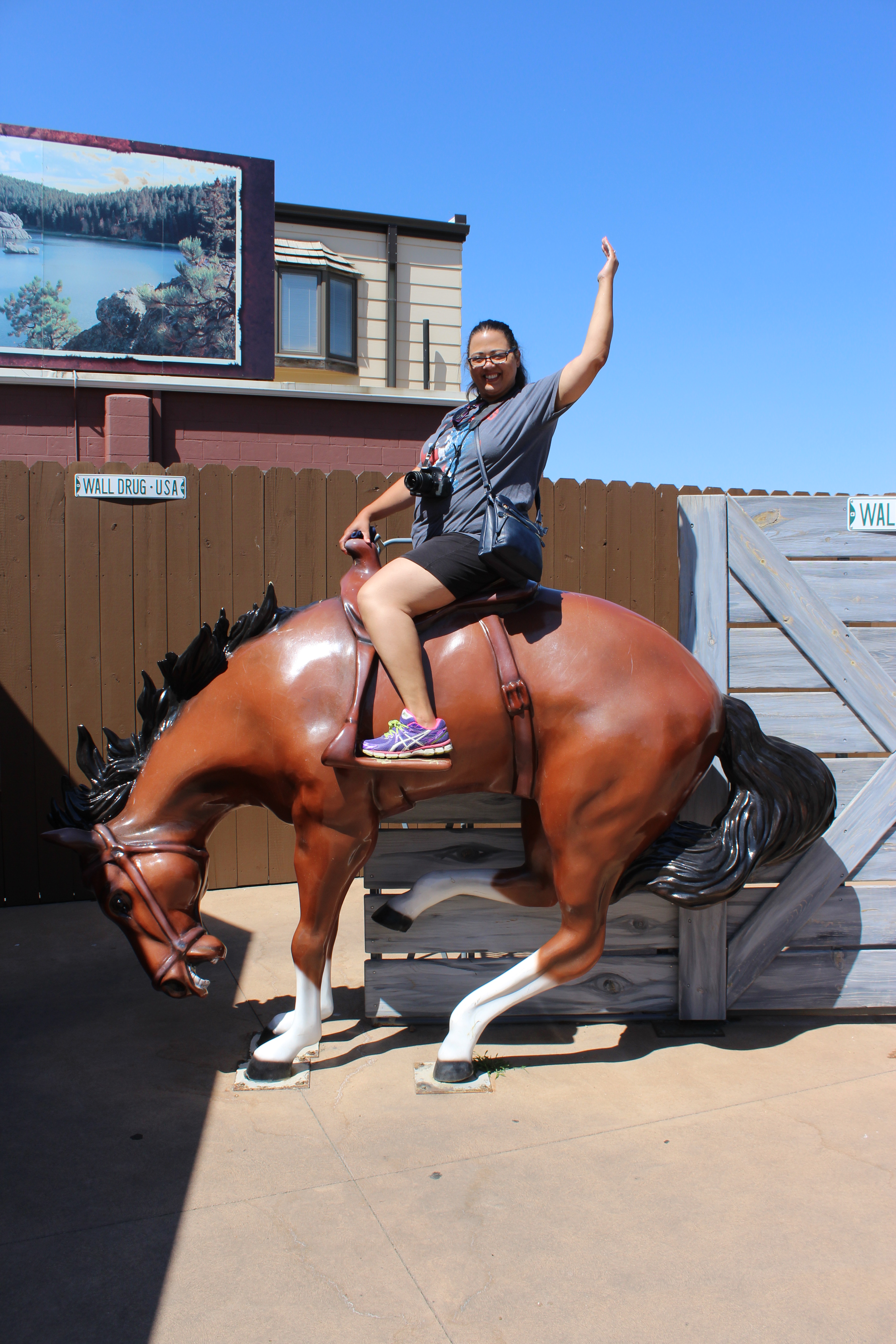
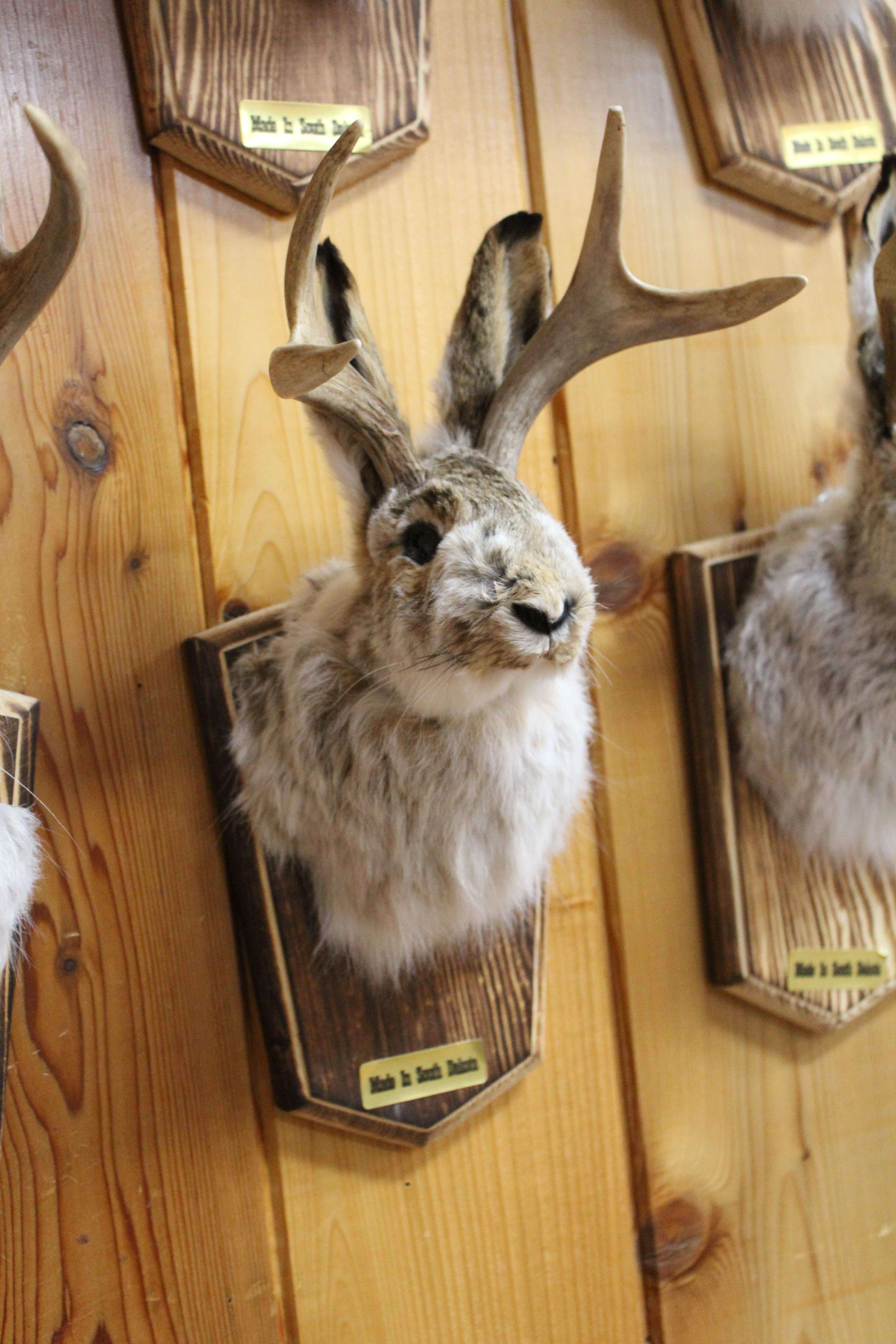
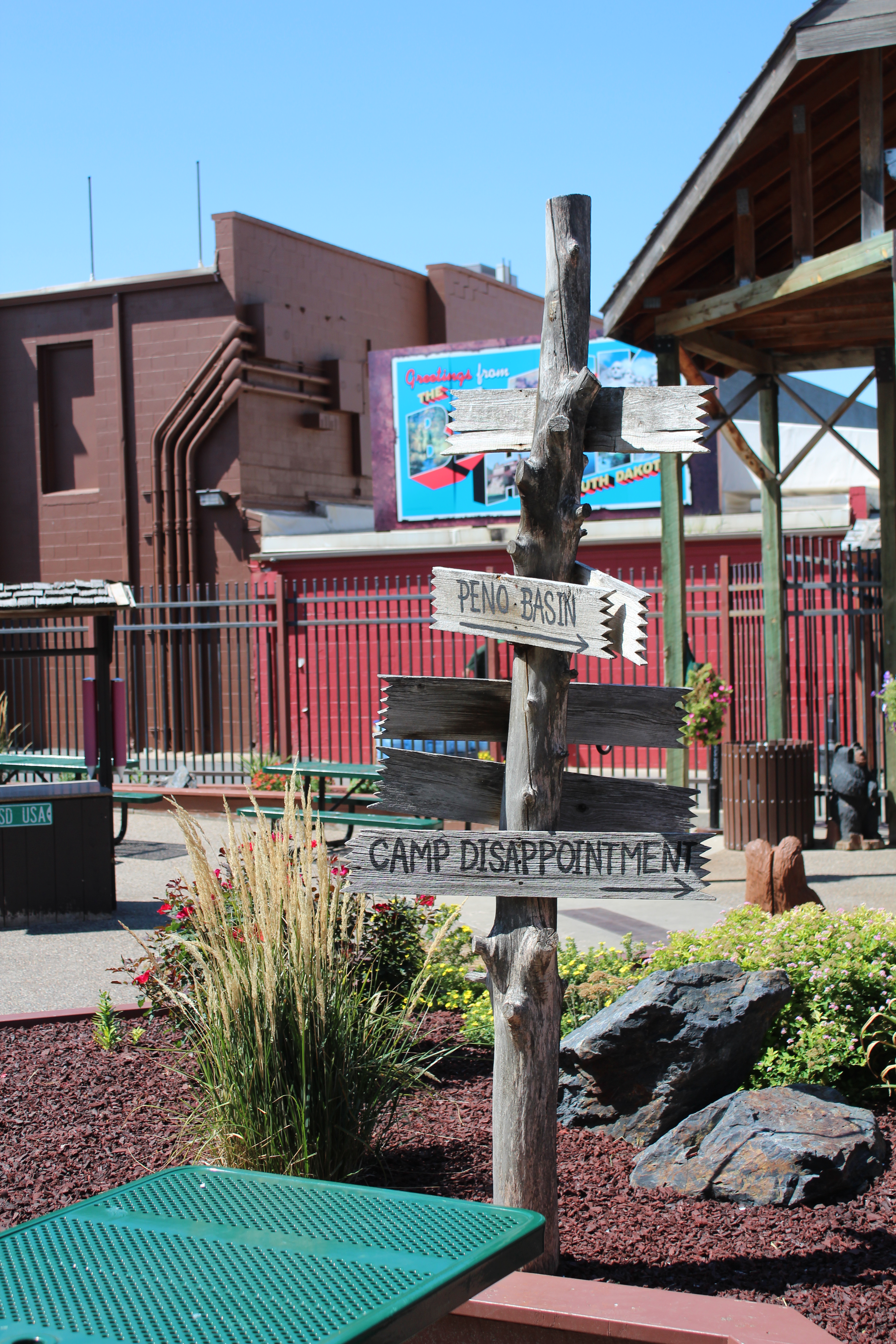
Despite that, after eating way too much, we perused the shops and exhibits, picking up a few new squished pennies to commemorate our visit. In one building we came face-to-face with a roaring animatronic T-rex, and in the “backyard” we took turns posing on various old-timey sets: a covered wagon, a jackalope, a miniature Mount Rushmore.

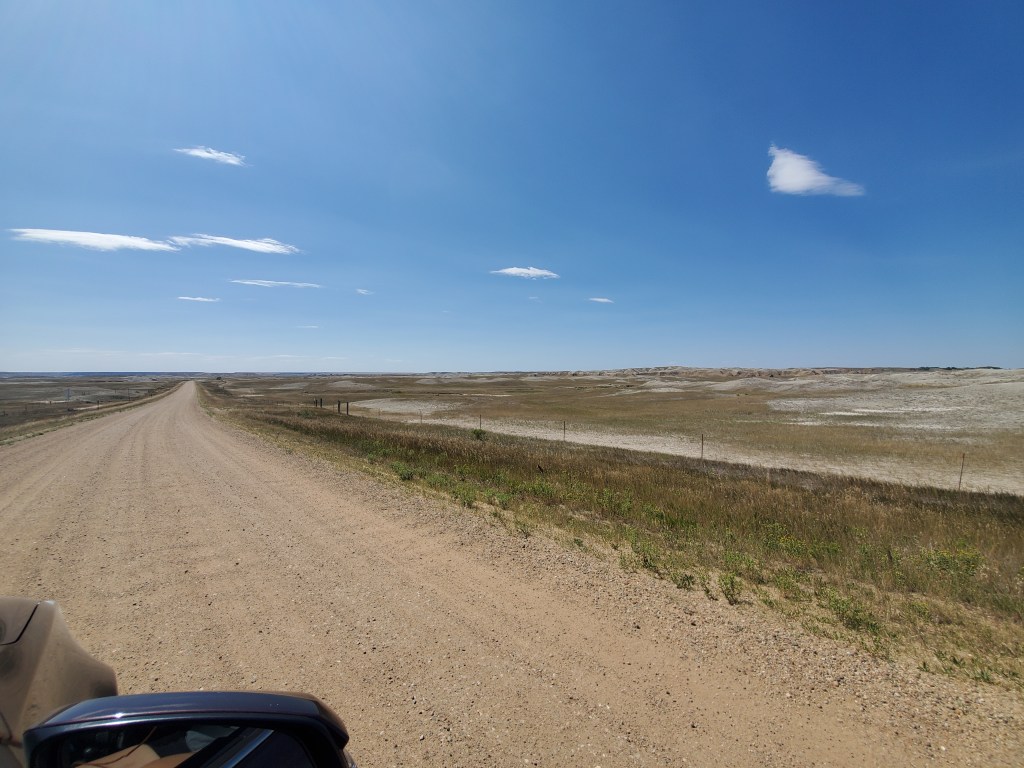
Then it was time to head out to our main destination for the day: Wounded Knee. With Google Maps leading the way, we set out on the hour and a half drive down a state highway. We hadn’t traveled too many miles when the highway suddenly turned into a gravel road. The farther we drove, the more remote it became, but what a beautiful drive!

For several miles the road was bordered by fields of sunflowers. In the distance we could see the Badlands while in the foreground prairie grass carpeted the fields. Every few miles we would pass a field full of prairie dog holes, with prairie dogs scampering around busily doing whatever it is that prairie dogs do. Periodically, we’d pass a sign that indicated we had entered or exited the Badlands National Park or the Badlands National Grasslands.

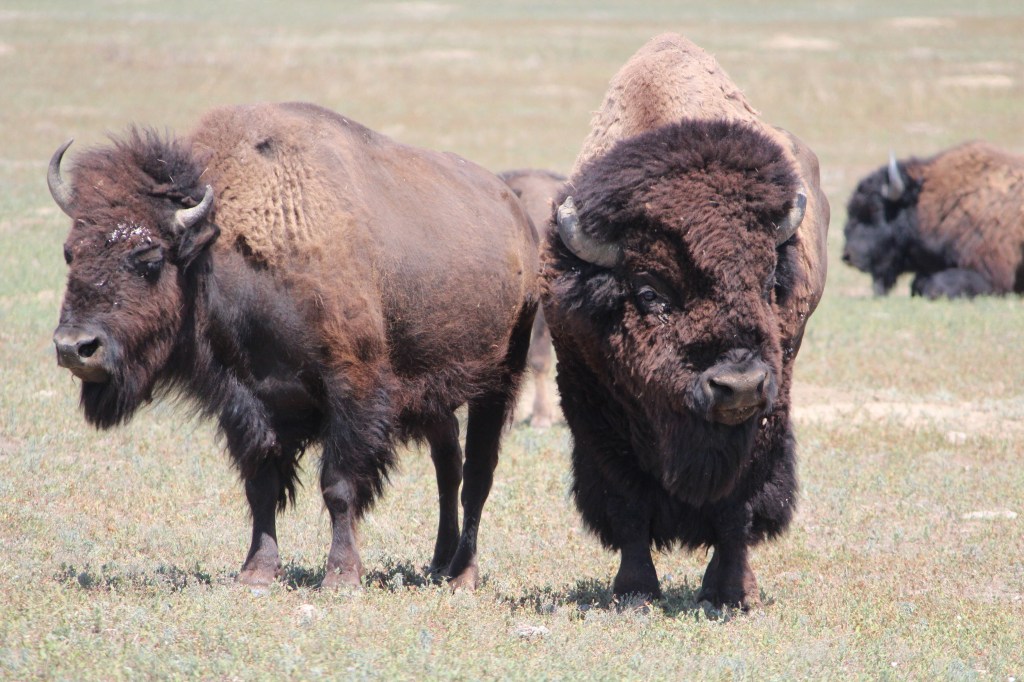
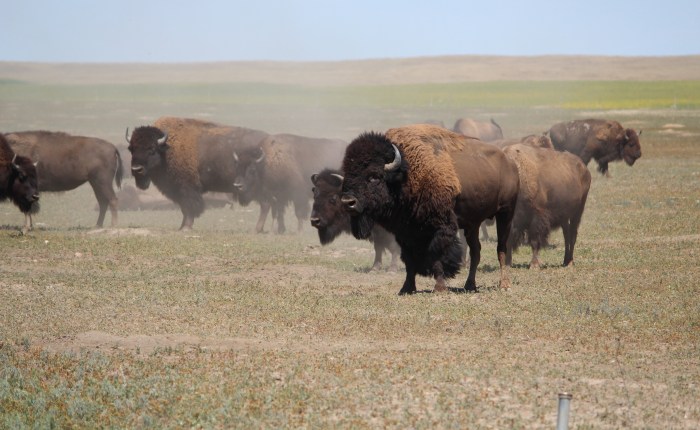
Suddenly we came over a rise and around a bend and in the fields and roadway in front of us was a large herd of bison roaming free. Those magnificent animals strolled back and forth across the road, unconcerned that they were holding up five or six cars who were waiting to pass through.
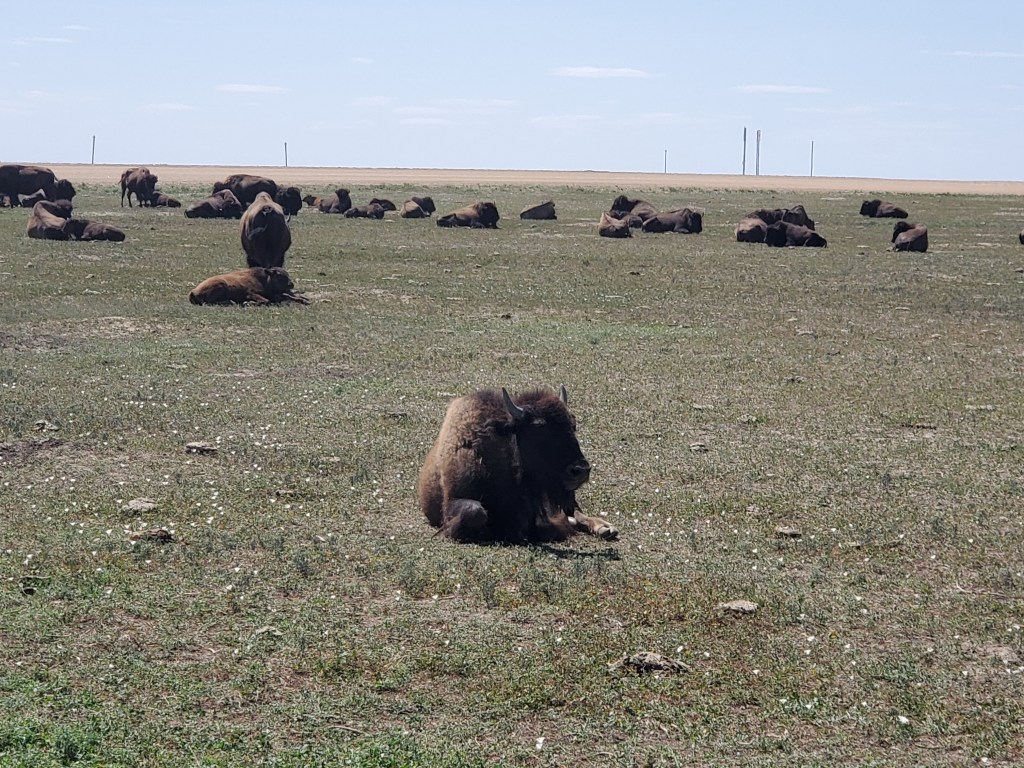
It was an amazing sight to see. We pulled over and hurriedly snapped photos from the safety of our vehicle. We inched our way through gaps in the herd, all the while listening to their grunts and snorts. Some of the bison were napping in the nearby fields or taking dust baths as they rolled around in the dirt. Calves played with other calves or nursed from their mothers. Others continually meandered back and forth across the road as if they couldn’t decide which side was better. One old male seemed frustrated that some of the others were ignoring his directions and his snorts became increasingly louder. I imagined how the same scene would have looked hundreds of years ago when there were a hundred times that many bison grazing on the plains.

What a treat it was to see those animals roaming wild and free. It honestly was one of my favorite experiences of the trip. (Just a reminder though: If you ever find yourself face-to-face with a bison, STAY IN YOUR CAR! They are large and powerful creatures that can very easily end you. Every year people die trying to take a photo with these animals. They are wild and unpredictable, and they are fast. Use a telephoto lens and shoot from your vehicle.)

After easing our way through the crowd of bison, we continued on our way. The scenery in that area of the country is just breathtaking. Photos can’t do it justice. It must be seen in person. After about 35 minutes of driving, we came to the entry gate of the Pine Ridge Indian Reservation on which Wounded Knee is located.

We were stopped by a very courteous young Lakota man who informed us that we would be unable to enter the reservation that day because of Covid-19 protocols. I knew that some reservations had suffered large outbreaks of Covid and had received little help from the government, but I never thought about the fact that they would need to close off access to Wounded Knee. He explained that to limit Covid spread, only individuals that had official business on the reservation could enter. “I’m sorry,” the young guard said, “but I’m going to have to turn you around.”

We thanked him for his kindness and wished him well and then did a U-turn and started back toward Wall. It was disappointing not to be able to pay our respects to the hundreds of natives who died at Wounded Knee, but it was more respectful to help protect them from their current death threat. Besides, I told my sister, if we hadn’t made the trip, we would never have seen the magnificent herd of bison. As far as I was concerned, the day trip was a complete success!

T-Rex at Wall Drug.
More about Wall Drug.
Party of Bison: These big guys were totally unconcerned about us!

Copyright 2021 Destination Investigations/V. Lori Hedges

All Photos and videos are the property of V. Lori Hedges and may not be used without permission.

Fort Pulaski: Discover this lesser known, but vital garrison in Civil War history

Fort Pulaski: Discover this lesser known, but vital garrison in Civil War history

By V. Lori Hedges

Two years ago, my family and I enjoyed a short trip to Savannah and Tybee Island, Georgia. Both areas were so beautiful and rich in history that we vowed to return as soon as we could. This summer we made good on that vow. This time, however, we had seven glorious days to spend enjoying this beautiful place, with lots of time for exploring or for doing nothing at all.

Fort Pulaski, located on Cockspur Island within sight of Tybee Island, was one place we couldn’t fit into our tight schedule last time, so we moved it to the top of our list of places to visit. My sister and I took advantage of a couple of sunny hours (before a rain storm moved in) to head over to the fort to expand our knowledge of southern history.

My family and I are very into history and visiting historical sites. But, despite the fact we have visited many historic sites, I was unprepared for how this place made me feel. Built in the early 1800s, the garrison’s 7-1/2-foot walls are constructed of giant slabs of stone and around 25 million bricks. According to park literature, most of the structure was built by slaves borrowed from nearby rice plantations. Although it happened almost 200 years ago, I felt pity for the laborers who had to work and sweat in the oppressive heat to build those massive walls.

The fort was originally built as a part of a campaign to secure the U.S. coastline from foreign threats. However, when neighboring South Carolina seceded from the United States and the union army was able to secure Fort Sumter in Charlestown, Georgia’s governor ordered the state’s militia to seize Fort Pulaski for the state. Later when Georgia seceded, it became a Confederate strong hold. What happened a year later is still recorded by the cannon projectiles imbedded in the outside walls.

IMG_1319
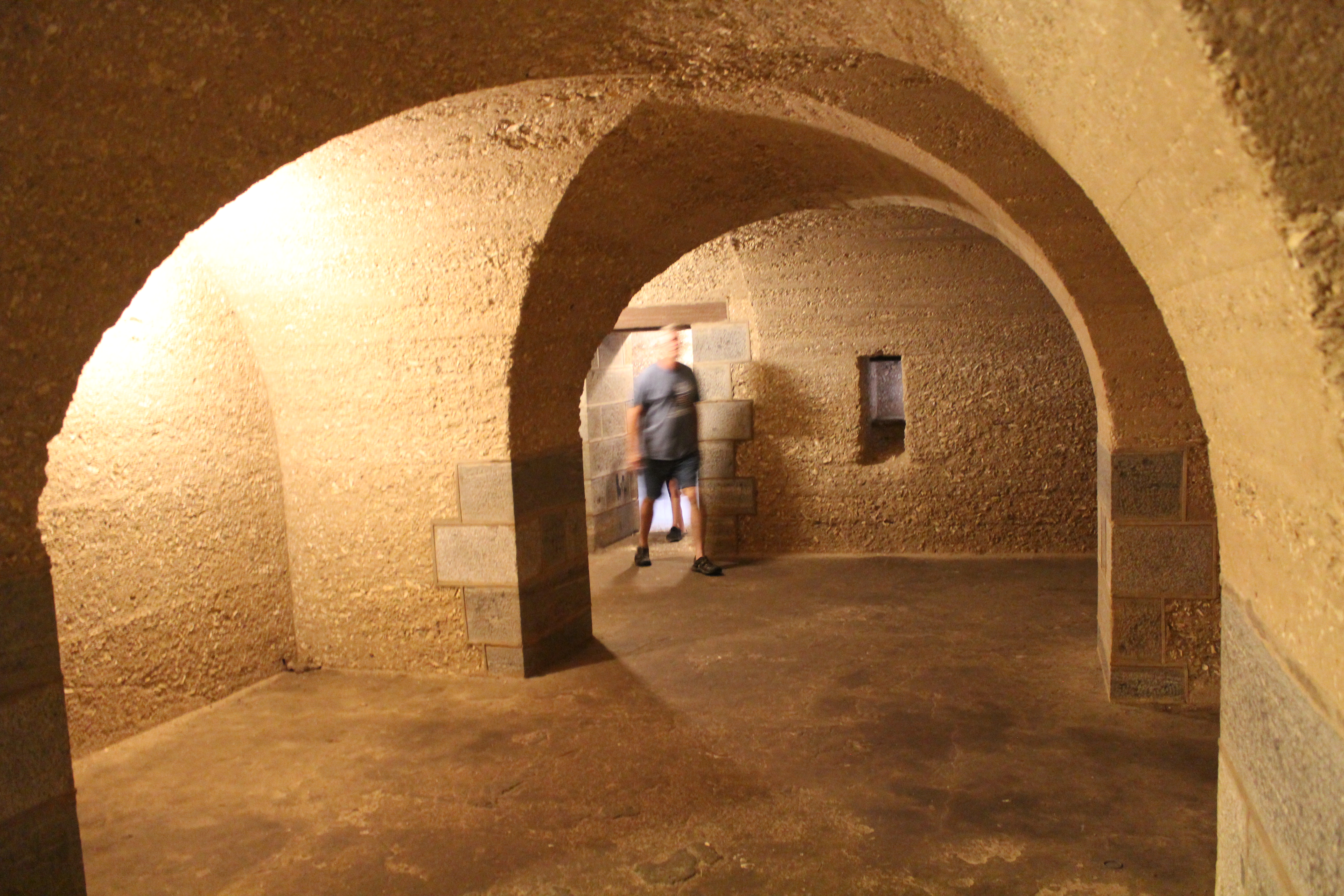
Visitors tour the underground chambers located inside and under the walls of Fort Pulaski.

Under the cover of night, the Union Army positioned rifled cannons in strategic locations across the water on Tybee Island. Because they didn’t know the Union was equipped with this new cannon technology, the Confederate soldiers thought they were safe and secure from the Union threat. Surely cannon couldn’t reach the walls from that far away, they thought, musing that if a cannon ball did happen to hit the fort, it would do little damage.

The battle lasted 30 short hours. The mighty garrison was no match for the rifled cannons and their capability to fire from far greater distances than traditional cannons. With massive holes blown in its side, Fort Pulaski was forced to surrender to the Union Army. For the rest of the Civil War, Fort Pulaski was a Union strong hold that allowed the United States to control the shipment of goods up the Savannah River. It also served as a prison for captured Confederate soldiers where many died of disease and starvation.

38872315_10156557806678936_6757832020337885184_n
The prison where many Confederate soldiers lived and died. 

Today Fort Pulaski stands proudly as one of our National Historic Monuments – a portal to the past – allowing visitors a chance to learn about what life was like on Cockspur Island in the 1800s.

As we meandered around within the walls of the fort, I could almost see the military personnel keeping watch along the upper walls while others tended to the massive cannons and other tasks around the interior. On Saturday’s, costumed reenactors populate the fort to give visitors an even more authentic experience as they go through the ceremony of firing several of the cannons on the garrison wall.

But even if you visit on a weekday, you just might meet a soldier in uniform. Since dozens of southern soldiers who were imprisoned there also died there, it is not surprising that people claim to see and hear their ghosts throughout the fort – even in the middle of the day.

Besides the fort itself, there are trails surrounding the garrison which allow visitors to explore the island’s plants and wildlife. And, although you can’t cross to it, there is a trail that takes you to a great vantage point to view the Cockspur Island lighthouse. Unfortunately, we didn’t get to take advantage of those offerings as about the time we finished our tour of the fort, the downpour arrived.

There is so much to learn here. The national park service has provided dozens of detailed plaques explaining how each area was used. There is also a wonderful short film in the welcome center about the battle between the Confederate and Union armies. As I walked around the fort, I couldn’t help but feel that the walls themselves were saturated with deep emotions: hope, deep despair, happiness, fear, pride, weariness … So much has happened here.

Fort Pulaski is such an interesting place. If you’re traveling near Tybee Island, I recommend you set aside a couple hours to wander around this historical gem. Admission is very inexpensive: $7 per adult. If you’re on vacation, this will probably be one of the least expensive, but most enriching experiences of your trip. I hope you find it to be as engaging as we did.

All photos are the property of V. Lori Hedges, and may not be used without permission.